Logo-300x300-colored-3
  • Home
  • Services
    • Offensive Security
    • Defensive Security
    • Privacy Engineering
    • AI Advisory
    • AI Assessment
    • AI Integration
  • Products
  • About
    • About Us
    • FAQ's
  • Resources
    • Blog
    • In The Media
    • Podcasts
    • All Resources
Get a Free Assessment
Back to Blog
Mean Time to Exploit Verizon DBIR 2026 remediation paradox vulnerability exploitation third party breach risk

The Remediation Paradox: Verizon's 2026 DBIR Shows Exploitation Winning While Defenders Patch Slower

Jacob Krell May 21, 2026 15 min read
Table of Contents

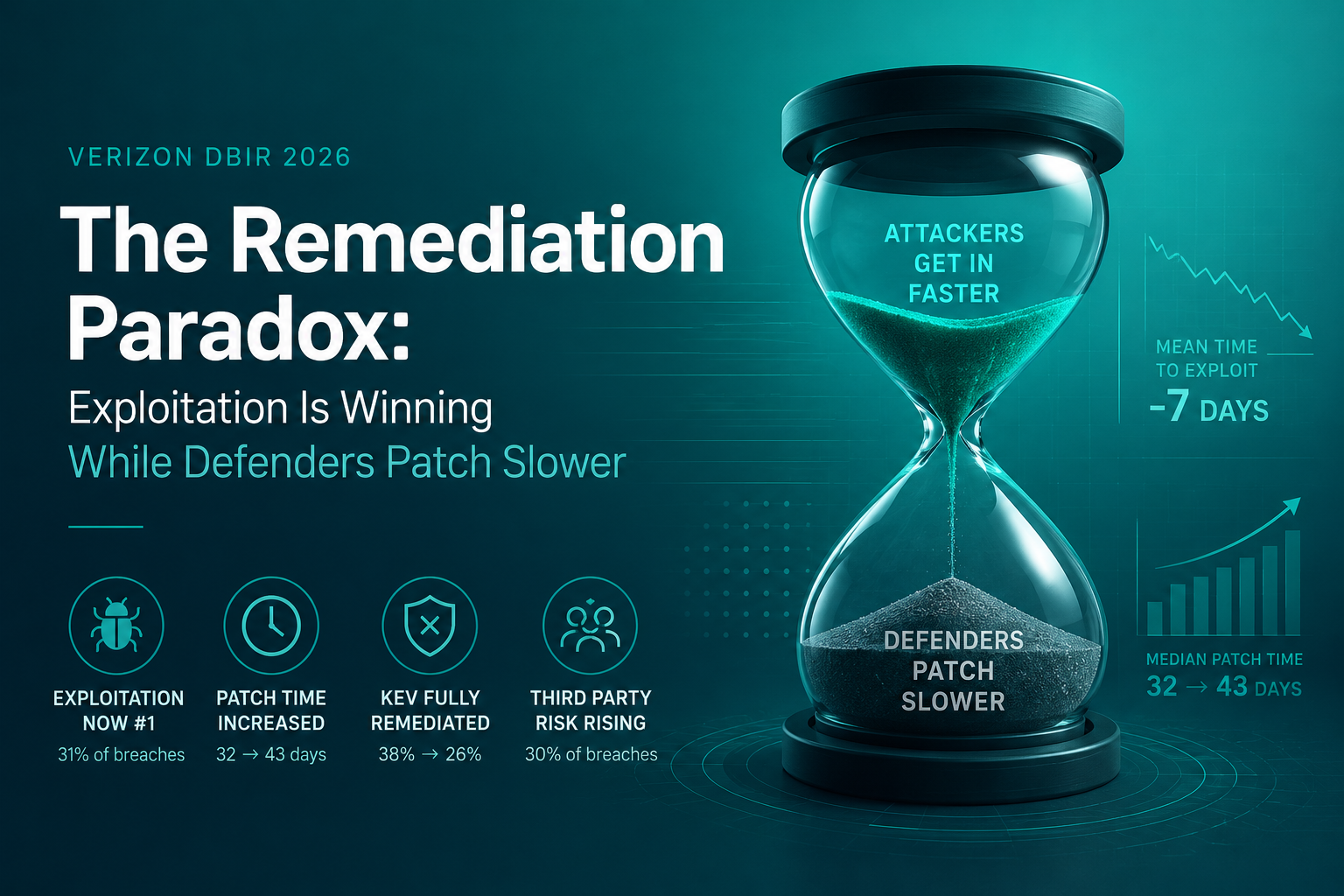
    On May 20, 2026, Verizon published the [2026 Data Breach Investigations Report](https://www.verizon.com/business/resources/reports/dbir/). The headline number is hard to miss. For the first time in the report's history, vulnerability exploitation overtook credential theft as the number one initial access vector in confirmed breaches. Exploitation rose to 31 percent of initial access cases. Credential abuse, long the dominant entry path, fell to 13 percent and lost the top spot entirely.

    The DBIR analyzed more than 22,000 confirmed breaches, roughly double the prior edition's 12,195. The dataset is larger, the signal is clearer, and the direction is the same story security leaders have been watching accelerate for three years. Attackers are getting in through flaws in software and infrastructure faster than organizations are closing them.

    At this point one is likely wondering whether the industry is finally catching up. The same report answers that question with a second headline that gets far less attention. Median patch time increased from 32 days to 43 days. The share of CISA Known Exploited Vulnerabilities fully remediated dropped from 38 percent to 26 percent. The top threat vector is rising. The primary industry response is slowing. That mismatch has a name and a structural explanation. This post will walk through both and make the case that patching alone cannot close a gap that is widening on both sides simultaneously.

    The Remediation Paradox

    The 2026 DBIR does more than confirm that exploitation is up. It documents a structural mismatch between how fast attackers operate and how fast defenders remediate. We call this The Remediation Paradox. The number one initial access vector is getting harder to defend against precisely because the gap between disclosure and compromise has inverted, while organizational remediation velocity is moving in the wrong direction at the same time.

    Patching faster remains necessary. It cannot close a gap that is widening faster than any single organization can patch, no matter how mature its vulnerability management program. Mandiant's M-Trends 2026 report puts estimated mean time to exploit at negative seven days. Exploitation now routinely occurs before a patch exists. When the decisive window sits entirely on the detection side of the timeline, a strategy built around closing every hole before an actor arrives is optimizing for a condition that the data says no longer holds.

    It is important to note that security teams are working harder than ever. Most organizations are patching more advisories, running more scanners, and buying more tools. The paradox is that the industry's collective answer to the DBIR still sounds like the answer from a decade ago. Patch faster. Scan more. Close the backlog.

    That recommendation addresses real exposure. It stops short of the capabilities the threat model now demands, in a way that aligns uncomfortably well with what the security vendor market sells. Patching platforms, vulnerability scanners, and compliance oriented remediation workflows are mature product categories with clear ROI narratives. Detection engineering, threat hunting, and adversary focused monitoring are harder to productize and harder to sell at scale. Every vendor summary of the 2026 DBIR will emphasize accelerated patching because that is what most vendors are built to deliver. The analysis tracks the business model. Organizations hear the same prescription because the industry sells the same prescription.

    For sake of clarity, naming that incentive dynamic is not an attack on vendors. Vulnerability management vendors solve a real problem. The gap is what gets left out of the bundle. When exploitation leads initial access and mean time to exploit is negative, the decisive organizational capability becomes time to detection, not time to patch. Programs that spend prevention heavy budgets on scanning and scheduling while threat hunting remains understaffed are responding to yesterday's breach pattern with tomorrow's invoice line items.

    In this way, The Remediation Paradox is a velocity problem dressed up as a tooling problem. Attackers compress the exploitation window with automation, prior compromise markets, and third party blast radius. Defenders expand patch timelines and celebrate scanner coverage. Both trends appear in the same annual report. Both trends cannot continue without breach costs continuing to set records.

    The Evidence Stack

    The DBIR is the anchor. It is not the full picture. Multiple independent research streams converged on the same conclusion before May 20, and they keep converging after it.

    Mean time to exploit and breakout speed

    Mandiant's M-Trends series tracks estimated mean time to exploit across years. In 2018, defenders had roughly 63 days between disclosure and in the wild exploitation. In 2024, the metric crossed zero. M-Trends 2026 places it at negative seven days.

    Year Estimated Mean Time to Exploit (Mandiant)
    2018 63 days
    2024 Crosses zero
    2025 -7 days

    CrowdStrike's 2026 Global Threat Report documents the operational speed on the other side of initial access. The fastest observed eCrime breakout time was 27 seconds. The average sat at 29 minutes. Eighty two percent of detections were malware free, meaning defenders cannot rely on traditional malware signals to catch the intrusion in progress.

    Prior compromise was the most frequently confirmed initial infection vector for ransomware in 2025 at 30 percent, according to Mandiant M-Trends 2026. That figure matters for remediation strategy. A ransomware event in 2026 is often the bill arriving for a foothold sold or planted months earlier. Patching the edge device on the day of encryption does not unwind the broker sale that already happened.

    The Crossover: Exploitation Overtakes Credentials
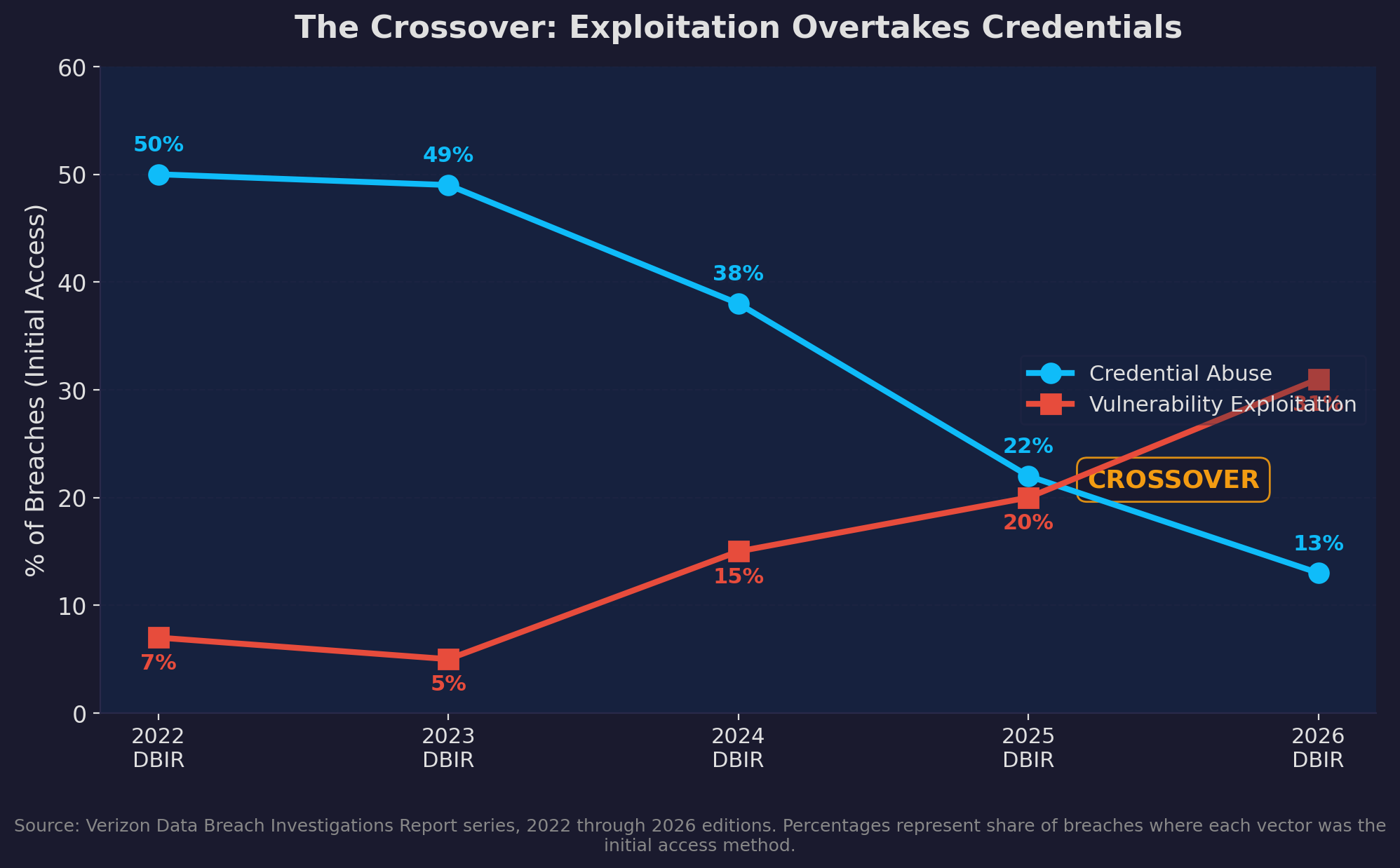
    dbir_exploitation_vs_credentials_crossover

    Third party compounding

    Exploitation is only one entry path. The DBIR also shows third party involvement reaching 48 percent of breaches, a 60 percent year over year increase from 30 percent in the prior edition.

    The Identity Theft Resource Center's 2025 Annual Data Breach Report found that supply chain attacks doubled between 2021 and 2025, and that approximately 30 percent of all breaches involve at least one third party. The numbers differ in scope and methodology, but the direction is identical. Breach harm increasingly originates outside the perimeter of the organization that signs the incident response retainer.

    It is important to consider that third party risk is not only frequency but remediation quality. The DBIR reports that only 23 percent of third party organizations had fully remediated missing MFA on cloud accounts. A vendor questionnaire that checks policy language without checking control implementation is measuring paper, not exposure.

    The governance gap described in recent supply chain analysis still applies. One compromised supplier, one poisoned extension, one unpatched SaaS integration, and dozens of downstream organizations inherit the blast radius. The acceleration in third party involvement tracks the same structural load bearing dynamic seen in vendor consolidation.

    Ransomware economics and the pivot to data

    Ransomware appeared in 48 percent of breaches in the 2026 DBIR, up from 44 percent. Prevalence is rising. Payment economics are moving the other way.

    According to the DBIR, median ransom payout fell to $140,000 from $150,000, and 69 percent of victims did not pay. Ninety six percent of ransomware victims were small and medium businesses. Half of ransomware victims had an infostealer leak within 95 days before the attack.

    Those figures sit together uncomfortably only if ransomware is treated as a single business model. A clearer read treats operators as rational economic actors seeking maximum margin. Where segmentation, backup resilience, and blast radius reduction have worked, encryption alone produces a declining payout. The industry preaching of immutable backups and tested restore paths has changed the math on the availability side of the extortion. The declining median payout is partly a testament to that defensive progress.

    Where data is worth more than downtime, operators pivot. Exfiltration, leak sites, and regulatory pressure replace or supplement encryption. Both dynamics are real at once. Ransomware involvement can rise while payouts fall because the campaign type is splitting. One path monetizes disruption. The other monetizes confidentiality at scale.

    Breach cost and the AI defensive gap

    IBM's 2025 Cost of a Data Breach Report provides the financial mirror. The US average breach cost reached $10.22 million, a 9.2 percent increase and a new record for the region. Organizations using AI powered security saved an estimated $1.9 million per breach. AI enabled organizations identified breaches in 148 days and contained them in 42 days. Organizations without AI powered security took 168 days to identify and 64 days to contain.

    Twenty six fewer days to identification and twenty two fewer days to containment translate directly to outcome. That gap is the difference between finding the actor internally and learning about the compromise from a partner, regulator, or criminal announcement.

    DBIR year over year key metrics

    Metric 2025 DBIR 2026 DBIR Change
    Vulnerability exploitation (initial access) 20% 31% +55%
    Credential abuse (initial access) #1 vector 13% Displaced
    Ransomware involvement 44% 48% +4 pts
    Third party involvement 30% 48% +60%
    Median patch time 32 days 43 days +34%
    KEV remediation rate 38% 26% -32%
    Confirmed breaches analyzed 12,195 22,000+ +80%

    Source: Verizon DBIR 2025 and 2026 editions.

    The Remediation Scissors

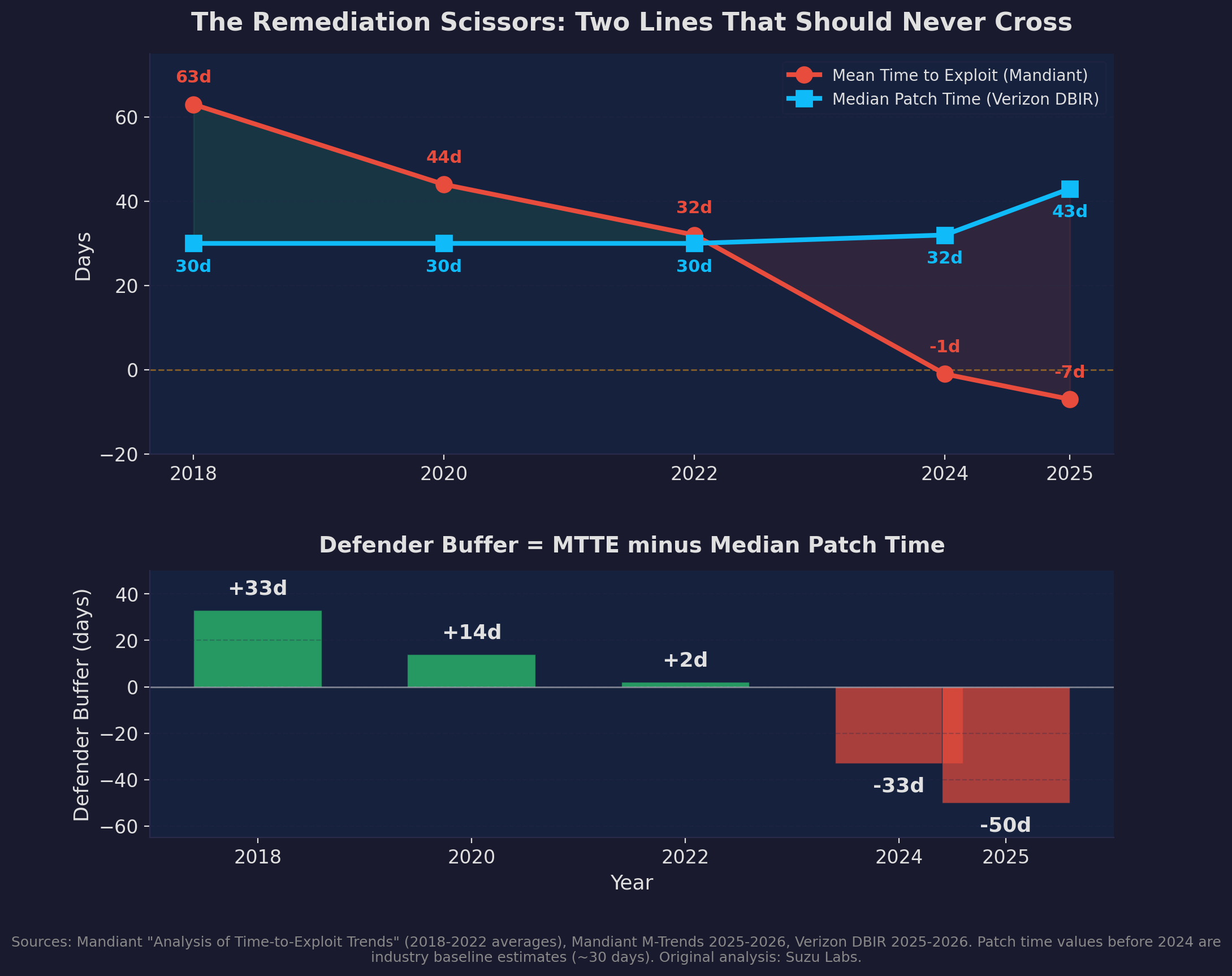
    Mandiant's M-Trends series tracks estimated mean time to exploit across years. Verizon's DBIR tracks median time for organizations to fully patch known exploited vulnerabilities. Plotting both lines on the same chart produces what we call The Remediation Scissors, two trend lines moving in opposite directions that crossed between 2022 and 2024 and have been diverging since.

    Year Mean Time to Exploit (Mandiant) Median Patch Time (Verizon DBIR) Defender Buffer
    2018 63 days ~30 days (industry baseline) +33 days
    2020 44 days ~30 days (industry baseline) +14 days
    2022 32 days ~30 days (industry baseline) +2 days
    2024 -1 day 32 days (2025 DBIR) -33 days
    2025 -7 days 43 days (2026 DBIR) -50 days

    *Sources: Mandiant "Analysis of Time-to-Exploit Trends" (2018-2019 average: 63 days, 2020-Q1 2021 average: 44 days, 2021-2022 average: 32 days), Mandiant M-Trends 2025 and 2026 (2024: -1 day, 2025: -7 days), Verizon DBIR 2025 and 2026 (median patch time). Patch time values before 2024 are industry baseline estimates. Defender buffer = MTTE minus median patch time. 
    remediation_scissors

    In 2018, defenders had a 33 day buffer. Exploitation typically followed disclosure by 63 days. Patching typically completed in about 30 days. That left roughly a month of margin. By 2022, the buffer had compressed to just two days. The scissors were closing. Then they collapsed. Between 2022 and 2024, the defender buffer crashed from +2 days to -33 days as exploitation timelines crossed zero and went negative. By 2025, the gap had widened to negative 50 days. Exploitation now precedes patch availability by a week, and the median organization still takes 43 days to deploy the patch once it exists.

    The scissors will not close through patching improvements alone. The exploitation line is driven by AI acceleration, prior compromise markets, and zero day availability. It is moving at a pace that no remediation program can match at scale. The only way to shorten the negative buffer is to add detection capability on top of remediation capability.

    The KEV Exposure Gap

    The DBIR provides two related numbers that most coverage reports independently. Organizations face a median of 16 KEV vulnerabilities requiring remediation. Only 26 percent of KEVs are fully remediated. Applied together, those figures produce a concrete and uncomfortable number.

    The median organization has approximately 12 unpatched known exploited vulnerabilities at any given time (16 KEVs assigned, 26 percent remediated, 12 remaining).

    Every vulnerability in the CISA KEV catalog has confirmed in the wild exploitation. Twelve of them are sitting unpatched in the median organization right now while the DBIR reports exploitation as the leading initial access vector at 31 percent. The exposure is measured, not hypothetical. It is the gap between what CISA says is being exploited and what the average organization has actually fixed.

    In the prior DBIR period, the equivalent calculation produced roughly 7 unpatched KEVs (38 percent remediation on a median of 11). The number has nearly doubled in a single year. The backlog is growing faster than remediation programs are clearing it.

    What Security Leaders Should Do Now

    The Remediation Paradox does not argue for abandoning patching. It argues for designing the security program around the assumption that prevention has already failed somewhere in the environment, because the data says it routinely has.

    Rebalance investment toward detection and threat hunting. The mean time to exploit collapse made the case before the DBIR arrived. The 2026 edition confirms it with exploitation leading initial access. The decisive control is time to detection. Budget, headcount, and executive attention should follow that fact. Weekly structured hunts, compromise assessments that start from adversary presence rather than alert queues, and behavioral analytics aimed at malware free intrusion chains belong in the same priority conversation as the next scanner renewal.

    Treat patching as necessary but insufficient. Continue patching. Do not slow down. Prioritize Known Exploited Vulnerabilities and internet facing exposure. In doing so, pair every remediation SLA with a detection hypothesis. If the patch ships on day forty three and exploitation can precede availability, the organization still needs visibility into whether the flaw was used on day two.

    Extend third party risk management beyond questionnaires. With 48 percent of breaches involving a third party, vendor risk programs must cover software supply chain exposure, developer tooling, and the remediation velocity of critical suppliers. Contractual notification timelines matter. So does evidence that partners actually fixed missing MFA on cloud accounts, not merely promised to.

    Monitor infostealer markets as ransomware early warning. Half of ransomware victims in the DBIR data had a stealer leak within 95 days before the attack. Credential monitoring in dark web and infostealer markets is now an early warning layer for ransomware exposure, not a niche threat intelligence exercise. When employee or service account credentials appear in a stealer log, the clock to ransomware is measurable.

    Deploy AI assisted defensive tooling. Organizations that restrict their security teams from AI capabilities do not reduce the offensive use case. They forfeit the defensive one. IBM's breach cost data quantifies the gap in dollars and days. AI assisted correlation, triage, and hunt hypothesis generation are how smaller teams approximate the pace CrowdStrike documents on the offensive side.

    The Gap Is Still Widening

    The 2026 DBIR lands in an environment where exploitation leads, patching slows, third party involvement jumps, and breach costs set US records. The question for 2026 and beyond is narrower than whether organizations will be affected. They will. The question is whether they learn about compromise from their own detection stack or from someone else's notification.

    As such, the industry conversation needs to move past the remediation paradox's comfortable prescription. Faster scanning alone does not answer malware free breakout measured in minutes, prior compromise sold before ransomware deployment, or third party MFA gaps that persist after assessment. Detection centric strategy is the structural response the data has been pointing toward since mean time to exploit crossed zero.

    At a Glance

    What happened. Verizon released the 2026 DBIR on May 20, 2026. Vulnerability exploitation became the leading initial access vector at 31 percent, displacing credential abuse at 13 percent, while median patch time rose to 43 days and KEV full remediation fell to 26 percent.

    Why it matters. The top threat vector and the industry's primary remediation response are diverging. That mismatch is The Remediation Paradox. Patching remains necessary but cannot close a gap where exploitation often precedes patch availability and vendor dominated analysis still disproportionately emphasizes the tools vendors sell.

    The trend. Mean time to exploit sits at negative seven days (Mandiant M-Trends 2026). Third party involvement hit 48 percent of breaches. Ransomware prevalence rose to 48 percent while median payouts fell, reflecting both industrialized cybercrime and improved backup and segmentation discipline.

    What to do. Rebalance toward threat hunting and detection. Keep patching aggressive but assume breach somewhere in the estate. Extend third party governance to real control verification. Treat infostealer monitoring as ransomware early warning. Deploy AI assisted defensive tooling and close the identification and containment gap IBM documents.

    Who is affected. Any organization relying on prevention heavy vulnerability programs without proportional detection investment. Small and medium businesses bear 96 percent of ransomware victim share in the DBIR data. Enterprises with dense third party and software supply chain dependency inherit compounded blast radius.


    Sources

    - Verizon, "2026 Data Breach Investigations Report," May 20, 2026, https://www.verizon.com/business/resources/reports/dbir/

    - Verizon, "2025 Data Breach Investigations Report," 2025, https://www.verizon.com/business/resources/reports/2025-dbir-executive-summary.pdf

    - Mandiant, "M-Trends 2026: Data, Insights, and Strategies From the Frontlines," Google Cloud, March 2026, https://cloud.google.com/blog/topics/threat-intelligence/m-trends-2026

    - Mandiant, "Analysis of Time-to-Exploit Trends: 2021-2022," Google Cloud Blog, https://cloud.google.com/blog/topics/threat-intelligence/time-to-exploit-trends-2021-2022/

    - CrowdStrike, "2026 Global Threat Report," February 2026, https://www.crowdstrike.com/en-us/press-releases/2026-crowdstrike-global-threat-report/

    - Identity Theft Resource Center, "2025 Annual Data Breach Report," January 2026, https://www.idtheftcenter.org/wp-content/uploads/2026/01/2025-ITRC-Annual-Data-Breach-Report.pdf

    - IBM, "2025 Cost of a Data Breach Report," 2025, https://www.ibm.com/reports/data-breach

    - SecurityWeek, "Verizon DBIR 2026: Vulnerability Exploitation Overtakes Credential Theft as Top Breach Vector," May 2026, https://www.securityweek.com/verizon-dbir-2026-vulnerability-exploitation-overtakes-credential-theft-as-top-breach-vector/


     

    Share
    Tags: Mean Time to Exploit Verizon DBIR 2026 remediation paradox vulnerability exploitation third party breach risk
    Jacob Krell
    Jacob Krell

    Jacob Krell builds systems that are hard to break and breaks systems that appear resilient. He is an offensive security leader specializing in advanced penetration testing and red teaming across cloud, web, mobile, Active Directory, and AI-enabled environments, helping organizations expose real-world risk and validate their defenses against modern adversaries. In parallel, he is a full-stack software engineer who develops custom cybersecurity tooling, intelligent automation platforms, and production-grade applications that embed security directly into the technology lifecycle. Ranked 25th globally on Hack The Box with more than 1,000 flags captured and holding many elite certifications, including OSCE3, CISSP, OSCP, CCNP Security, and CSIE, Jacob combines hands-on technical depth with the ability to translate complex cyber risk into clear business strategy.

    Suzu Labs provides vCISO services with integrated threat hunting and vulnerability management advisory.

    If your organization needs help rebalancing from prevention centric to detection centric security strategy, we can help.

    Get In Touch
    ← Previous The Extension Blind Spot: How One VS Code Plugin Gave Attackers GitHub's Source Code

    Latest Posts

    View All
    The Remediation Paradox: Verizon's 2026 DBIR Shows Exploitation Winning While Defenders Patch Slower
    Mean Time to Exploit
    May 21, 2026 Jacob Krell

    The Remediation Paradox: Verizon's 2026 DBIR Shows Exploitation Winning While Defenders Patch Slower

    On May 20, 2026, Verizon published the [2026 Data Breach Investigations ...

    Read More: The Remediation Paradox: Verizon's 2026 DBIR Shows Exploitation Winning While Defenders Patch Slower
    The Extension Blind Spot: How One VS Code Plugin Gave Attackers GitHub's Source Code
    Cybersecurity
    May 20, 2026 Jacob Krell

    The Extension Blind Spot: How One VS Code Plugin Gave Attackers GitHub's Source Code

    GitHub's 3,800 Repositories Stolen Through a Single IDE Extension On May 19, 2026, a single VS Code extension on a ...

    Read More: The Extension Blind Spot: How One VS Code Plugin Gave Attackers GitHub's Source Code
    The Cost of a Click: Why Passive Cookie Consent Is Your Biggest Compliance Liability
    May 20, 2026 Hannah Perez

    The Cost of a Click: Why Passive Cookie Consent Is Your Biggest Compliance Liability

    If you think a basic pop-up banner that reads "By continuing to browse this site, you accept cookies" protects your ...

    Read More: The Cost of a Click: Why Passive Cookie Consent Is Your Biggest Compliance Liability
    Five Years of US Privacy Breach Data Tell a Story Security Leaders Cannot Ignore
    Data Privacy
    May 19, 2026 Jacob Krell

    Five Years of US Privacy Breach Data Tell a Story Security Leaders Cannot Ignore

    In April 2026 alone, the ShinyHunters extortion group breached ADT (5.5 million customers), Amtrak (2.1 million ...

    Read More: Five Years of US Privacy Breach Data Tell a Story Security Leaders Cannot Ignore
    Mean Time to Exploit Has Gone Negative. Security Strategy Has to Change.
    Vulnerability Management
    May 05, 2026 Jacob Krell

    Mean Time to Exploit Has Gone Negative. Security Strategy Has to Change.

    Mandiant's M-Trends 2026 report puts estimated mean time to exploit at negative seven days. That number should reset ...

    Read More: Mean Time to Exploit Has Gone Negative. Security Strategy Has to Change.
    When AI Billing Breaks Trust: What the Claude Code Backlash Says About AI Governance
    Prompt Injection
    Apr 30, 2026 Hannah Perez

    When AI Billing Breaks Trust: What the Claude Code Backlash Says About AI Governance

    When AI Billing Breaks Trust: Lessons from the Claude Code Backlash AI adoption is accelerating, but trust is still ...

    Read More: When AI Billing Breaks Trust: What the Claude Code Backlash Says About AI Governance
    From Army Ranger to Ethical Hacker: What Cybersecurity Can Learn from the Battlefield
    Cybersecurity
    Apr 29, 2026 Suzu Labs

    From Army Ranger to Ethical Hacker: What Cybersecurity Can Learn from the Battlefield

    Cybersecurity doesn’t start with tools, it starts with mindset. In this episode featuring Aaron Colclough, we get a ...

    Read More: From Army Ranger to Ethical Hacker: What Cybersecurity Can Learn from the Battlefield
    When Elite Cyber Teams Can't Crack Web Security
    Cybersecurity
    Apr 23, 2026 Jacob Krell

    When Elite Cyber Teams Can't Crack Web Security

    HTB's 2025 benchmark tested 796 security teams. Only 21% passed web security challenges. The Security Illusion Security ...

    Read More: When Elite Cyber Teams Can't Crack Web Security
    The Invisible Threat: Business Logic Flaws in Modern Applications and Why Scanners Miss Them
    Cybersecurity
    Apr 22, 2026 Jacob Krell

    The Invisible Threat: Business Logic Flaws in Modern Applications and Why Scanners Miss Them

    In today's security landscape, some of the most dangerous vulnerabilities aren't flagged by automated scanners at all. ...

    Read More: The Invisible Threat: Business Logic Flaws in Modern Applications and Why Scanners Miss Them
    Suzu Labs Acquires Emulated Criminals
    Apr 20, 2026 Hannah Perez

    Suzu Labs Acquires Emulated Criminals

    Bridging the gap between theory and the threat reality, Suzu Labs is proud to announce the acquisition of Emulated ...

    Read More: Suzu Labs Acquires Emulated Criminals
    The Wall Around Claude 4.7 Does Not Extend to Dread
    Cybersecurity
    Apr 17, 2026 Suzu Labs

    The Wall Around Claude 4.7 Does Not Extend to Dread

    Anthropic released Claude Opus 4.7 on April 16, 2026 with automated cybersecurity safeguards and a Cyber Verification ...

    Read More: The Wall Around Claude 4.7 Does Not Extend to Dread
    The Engagement Ratchet: How YouTube, Instagram, and Amazon Trained Users to Accept Less Control
    youtube
    Apr 10, 2026 Jacob Krell

    The Engagement Ratchet: How YouTube, Instagram, and Amazon Trained Users to Accept Less Control

    Earlier this year, YouTube began rolling out a row of algorithmically recommended videos at the top of the ...

    Read More: The Engagement Ratchet: How YouTube, Instagram, and Amazon Trained Users to Accept Less Control
    The AI Revolution: How Jobs Will Change by 2030
    Cybersecurity
    Apr 07, 2026 Suzu Labs

    The AI Revolution: How Jobs Will Change by 2030

    Host Phillip Wylie sits down with Nicolas Chaillan to discuss the sobering reality of AI replacement, the critical need ...

    Read More: The AI Revolution: How Jobs Will Change by 2030
    The Rosie Protocol: Is AI-Driven Personalized Medicine Finally Here?
    Generative AI
    Apr 01, 2026 Hannah Perez

    The Rosie Protocol: Is AI-Driven Personalized Medicine Finally Here?

    In late 2024, Sydney tech entrepreneur Paul Conyngham was told his rescue dog, Rosie, had months to live. She was ...

    Read More: The Rosie Protocol: Is AI-Driven Personalized Medicine Finally Here?
    From Analog Hacks to Agentic AI: The Evolution of Offensive Security with Denis Calderone
    Cybersecurity
    Mar 30, 2026 Suzu Labs

    From Analog Hacks to Agentic AI: The Evolution of Offensive Security with Denis Calderone

    The world of cybersecurity has undergone a massive transformation in just a few decades. In this episode of Simply ...

    Read More: From Analog Hacks to Agentic AI: The Evolution of Offensive Security with Denis Calderone
    While TSA Made Headlines, CISA Went Dark
    Critical Infrastructure
    Mar 30, 2026 Jacob Krell

    While TSA Made Headlines, CISA Went Dark

    The Department of Homeland Security has been partially shut down for over 45 days. In that time, 460 TSA officers have ...

    Read More: While TSA Made Headlines, CISA Went Dark
    The Purple Team Advantage: Bridging the Gap Between Hacking and Management with Chris Marks
    AI Security
    Mar 30, 2026 Suzu Labs

    The Purple Team Advantage: Bridging the Gap Between Hacking and Management with Chris Marks

    In cybersecurity, we often operate in silos. The red team breaks things, the blue team fixes them, and management ...

    Read More: The Purple Team Advantage: Bridging the Gap Between Hacking and Management with Chris Marks
    Claude Mythos and the Cybersecurity Risk That Was Already Here
    Threat Intelligence
    Mar 27, 2026 Jacob Krell

    Claude Mythos and the Cybersecurity Risk That Was Already Here

    On March 26, Anthropic confirmed the existence of Claude Mythos, an unreleased AI model described internally as "a step ...

    Read More: Claude Mythos and the Cybersecurity Risk That Was Already Here
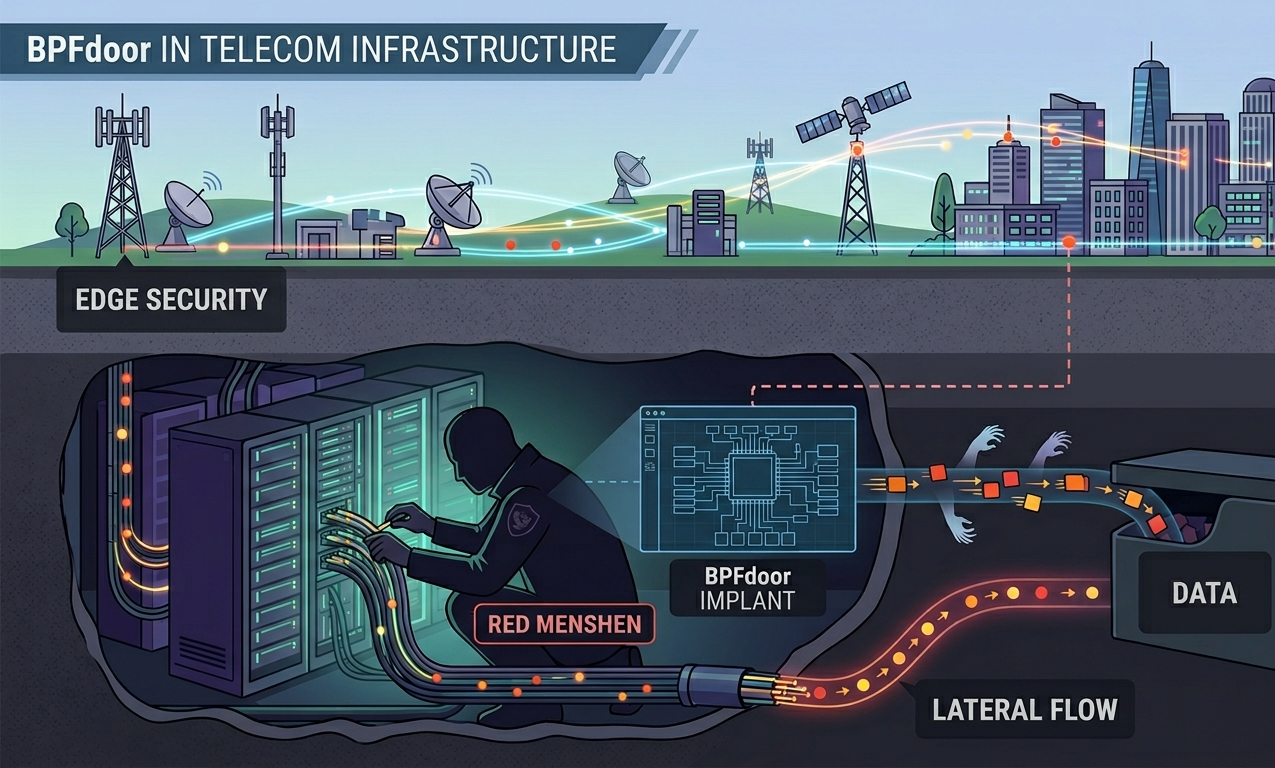
    BPFdoor in Telecom Networks: The FCC Is Securing the Edge, but China's Hackers Are Already Past It
    Critical Infrastructure
    Mar 26, 2026 Mike Bell

    BPFdoor in Telecom Networks: The FCC Is Securing the Edge, but China's Hackers Are Already Past It

    Rapid7's research reveals China-linked kernel implants deep inside telecom signaling infrastructure. Here's what ...

    Read More: BPFdoor in Telecom Networks: The FCC Is Securing the Edge, but China's Hackers Are Already Past It
    Securing the AI Frontier: Suzu Labs Sweeps 4 Global InfoSec Awards 2026
    Cybersecurity
    Mar 23, 2026 Hannah Perez

    Securing the AI Frontier: Suzu Labs Sweeps 4 Global InfoSec Awards 2026

    We are incredibly proud to announce a monumental achievement. At this year’s Global InfoSec Awards 2026, hosted by ...

    Read More: Securing the AI Frontier: Suzu Labs Sweeps 4 Global InfoSec Awards 2026
    From Cockpits to Code: Josh Mason on Bridging the Gap Between Military and Cybersecurity
    Cybersecurity
    Mar 17, 2026 Suzu Labs

    From Cockpits to Code: Josh Mason on Bridging the Gap Between Military and Cybersecurity

    In the world of cybersecurity, we often talk about "gatekeeping" or the "skills gap," but rarely do we find individuals ...

    Read More: From Cockpits to Code: Josh Mason on Bridging the Gap Between Military and Cybersecurity
    Simply Offensive Podcast: The Future of Pentesting: AI, Automation, and Better Reporting with Dan DeCloss
    Cybersecurity
    Mar 16, 2026 Phillip Wylie

    Simply Offensive Podcast: The Future of Pentesting: AI, Automation, and Better Reporting with Dan DeCloss

    The Future of Pentesting: AI, Automation, and Better Reporting with Dan DeCloss In this episode of Simply Offensive, ...

    Read More: Simply Offensive Podcast: The Future of Pentesting: AI, Automation, and Better Reporting with Dan DeCloss
    From Silence to Strike: Tracking Iran's Cyber Escalation in Real Time
    Critical Infrastructure
    Mar 13, 2026 Denis Calderone

    From Silence to Strike: Tracking Iran's Cyber Escalation in Real Time

    On March 12, medical technology giant Stryker confirmed a cyberattack that wiped devices across 79 countries. The ...

    Read More: From Silence to Strike: Tracking Iran's Cyber Escalation in Real Time
    Internal Analysis: Even Realities G2 Smart Glasses Security & Privacy Investigation
    Social Engineering
    Mar 09, 2026 Suzu Labs Intelligence

    Internal Analysis: Even Realities G2 Smart Glasses Security & Privacy Investigation

    Executive Summary Even Realities markets its G2 smart glasses as the privacy-conscious alternative to Meta Ray-Bans. ...

    Read More: Internal Analysis: Even Realities G2 Smart Glasses Security & Privacy Investigation
    The Company Reviewing Your Meta Glasses Footage Has a Security Problem
    Threat Intelligence
    Mar 06, 2026 Mike Bell

    The Company Reviewing Your Meta Glasses Footage Has a Security Problem

    Last week, Swedish journalists revealed that Meta sends video footage from Meta Ray-Ban smart glasses to human data ...

    Read More: The Company Reviewing Your Meta Glasses Footage Has a Security Problem
    The Death of the CTF: How Agentic AI Is Reshaping Competitive Hacking
    CTF
    Mar 03, 2026 Jacob Krell

    The Death of the CTF: How Agentic AI Is Reshaping Competitive Hacking

    View White Paper Abstract: Agentic AI systems are compressing competitive hacking timelines faster than the ...

    Read More: The Death of the CTF: How Agentic AI Is Reshaping Competitive Hacking
    Simply Offensive Podcast: AI Killed the CTF Star with Jacob Krell
    Cybersecurity
    Mar 03, 2026 Phillip Wylie

    Simply Offensive Podcast: AI Killed the CTF Star with Jacob Krell

    In this thought-provoking episode of Simply Offensive, host Philip Wylie sits down with Jacob Krell, a penetration ...

    Read More: Simply Offensive Podcast: AI Killed the CTF Star with Jacob Krell
    Anthropic and Claude: 2026 AI Powerhouse
    Supply Chain Security
    Feb 26, 2026 Hannah Perez

    Anthropic and Claude: 2026 AI Powerhouse

    In early 2026, the image of Anthropic as a cautious, safety-oriented "research lab" has effectively been replaced by ...

    Read More: Anthropic and Claude: 2026 AI Powerhouse
    Simply Offensive Podcast: Navigating AI's Challenges in Problem Solving with Darius Houle
    Cybersecurity
    Feb 24, 2026 Phillip Wylie

    Simply Offensive Podcast: Navigating AI's Challenges in Problem Solving with Darius Houle

    In this episode of Simply Offensive, host Philip Wylie welcomes Darius Houle, an Application Security (AppSec) and ...

    Read More: Simply Offensive Podcast: Navigating AI's Challenges in Problem Solving with Darius Houle
    Simply Offensive Podcast: Exploring the World of Hardware Hacking with Matt Brown
    Cybersecurity
    Feb 17, 2026 Phillip Wylie

    Simply Offensive Podcast: Exploring the World of Hardware Hacking with Matt Brown

    In the latest episode of the Simply Offensive podcast, host Philip Wylie sat down with Matt Brown, a renowned hardware ...

    Read More: Simply Offensive Podcast: Exploring the World of Hardware Hacking with Matt Brown
    Simply Offensive Podcast: Exploring AI Vulnerabilities in Cybersecurity with Mike Bell of Suzu Labs
    Cybersecurity
    Feb 12, 2026 Phillip Wylie

    Simply Offensive Podcast: Exploring AI Vulnerabilities in Cybersecurity with Mike Bell of Suzu Labs

    In today’s rapidly evolving technological landscape, the convergence of artificial intelligence (AI) and cybersecurity ...

    Read More: Simply Offensive Podcast: Exploring AI Vulnerabilities in Cybersecurity with Mike Bell of Suzu Labs
    Simply Offensive Podcast: Emulated Cyber Crime with Dahvid Schloss
    Threat Intelligence
    Feb 10, 2026 Phillip Wylie

    Simply Offensive Podcast: Emulated Cyber Crime with Dahvid Schloss

    Beyond the Pentest: Why Adversarial Emulation is the Future of Defensive Training Many organizations operate under the ...

    Read More: Simply Offensive Podcast: Emulated Cyber Crime with Dahvid Schloss
    Under Armour Breach: What The Forum Data Actually Shows
    Threat Intelligence
    Jan 30, 2026 Mike Bell

    Under Armour Breach: What The Forum Data Actually Shows

    On January 18, 2026, the Everest ransomware group made good on their threat and released Under Armour customer data to ...

    Read More: Under Armour Breach: What The Forum Data Actually Shows
    SilentFrame: A Research POC on Post-Exploitation Credential Collection through Browsers
    Briefing Room
    Jan 29, 2026 Dahvid Schloss

    SilentFrame: A Research POC on Post-Exploitation Credential Collection through Browsers

    This article is in reference to our newest POC hosted on GitHub here: https://github.com/Emulated-Criminals/SilentFrame ...

    Read More: SilentFrame: A Research POC on Post-Exploitation Credential Collection through Browsers
    Brightspeed Breach: Crimson Collective and the Infostealer Problem
    Threat Intelligence
    Jan 20, 2026 Mike Bell

    Brightspeed Breach: Crimson Collective and the Infostealer Problem

    Recently Crimson Collective claimed they breached Brightspeed and grabbed 1 million+ customer records. The list of data ...

    Read More: Brightspeed Breach: Crimson Collective and the Infostealer Problem
    When Grid Data Goes Dark Web
    Power Grid
    Jan 19, 2026 Mike Bell

    When Grid Data Goes Dark Web

    Inside a threat actor's critical infrastructure targeting In January 2026, 139 gigabytes of engineering data from a ...

    Read More: When Grid Data Goes Dark Web
    The $150,000 Password
    Critical Infrastructure
    Jan 19, 2026 Mike Bell

    The $150,000 Password

    How one threat actor turned stolen credentials into a global breach portfolio Between December 2025 and January 2026, a ...

    Read More: The $150,000 Password
    Seeing Everything, Understanding Nothing
    Briefing Room
    Jan 16, 2026 Dahvid Schloss

    Seeing Everything, Understanding Nothing

    To help you get a head start on making your environment safer and in keeping with the theme of January’s “New Year, New ...

    Read More: Seeing Everything, Understanding Nothing
    New Year, New Priorities - So, what to fix first?
    Briefing Room
    Jan 08, 2026 Dahvid Schloss

    New Year, New Priorities - So, what to fix first?

    The most common phrase we hear from our prospects is, “We are overwhelmed, and we aren’t sure what to tackle first.” ...

    Read More: New Year, New Priorities - So, what to fix first?
    UnderByte — A Ransomware experiment using Alternate Data Streams (ADS)
    Briefing Room
    Nov 21, 2025 Dahvid Schloss

    UnderByte — A Ransomware experiment using Alternate Data Streams (ADS)

    Repository purpose: this research was to evaluate the feasiabilty of using Alternate Data Stream (ADS) in staging and ...

    Read More: UnderByte — A Ransomware experiment using Alternate Data Streams (ADS)
    Logo copy 3-1

    Fortified Security. Intelligent Innovation.

    +1 (702) 766-6257
    P.O. Box 750111
    Las Vegas, Nevada 89136

    Follow Us

    About

    • About Us
    • Contact
    • FAQ's

    Solutions

    • Products
    • AI Advisory
    • AI Assessment
    • Offensive Security
    • Defensive Security
    • Adversarial Operations
    • Social Engineering

    Resources

    • Blog
    • In The Media
    • Podcasts
    © 2026 All rights reserved.
    • Privacy Policy
    • Terms & Conditions