.png)

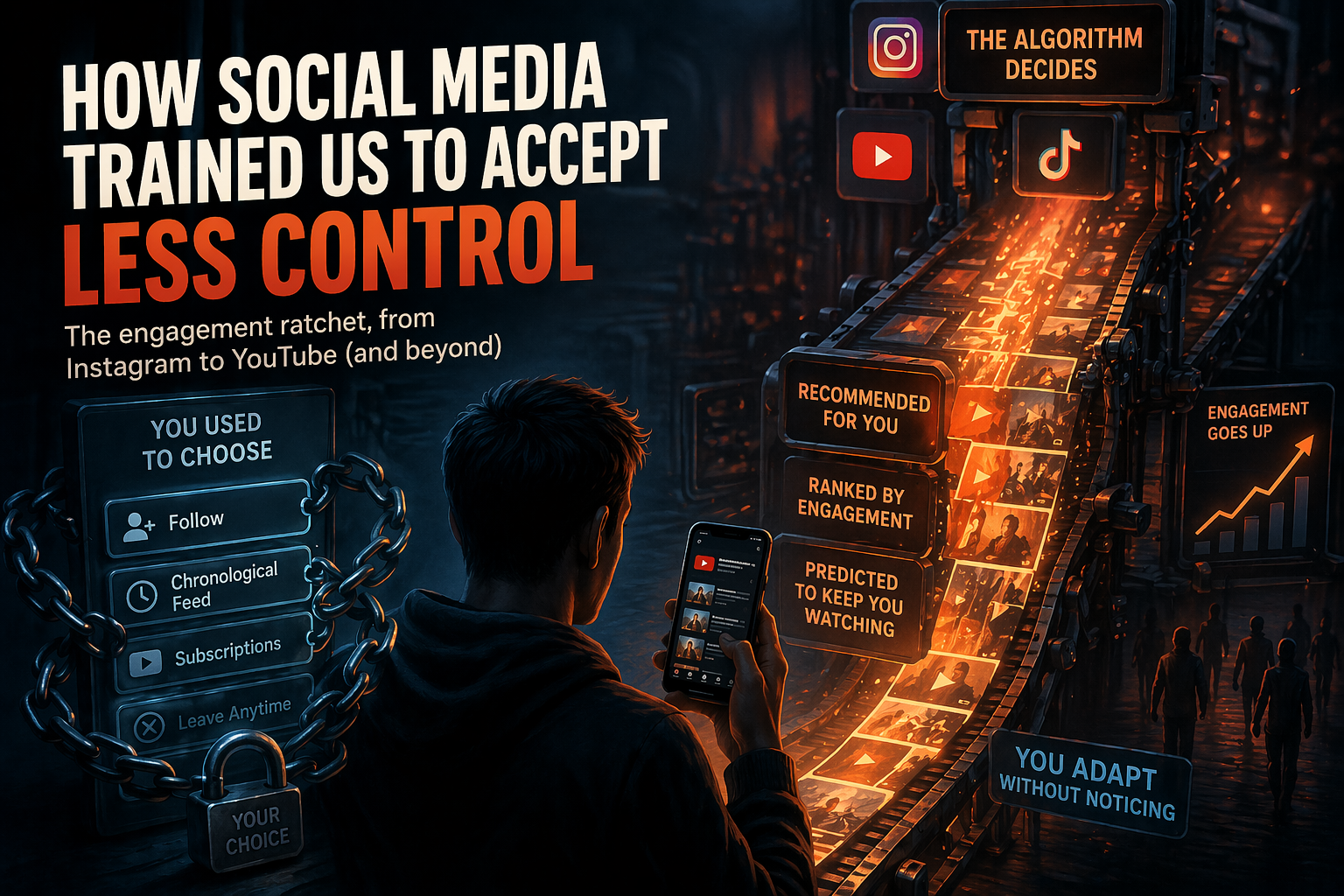
Earlier this year, YouTube began rolling out a row of algorithmically recommended videos at the top of the Subscriptions page. The section, labeled "most relevant," surfaces content the algorithm predicts the user will engage with, pulled from channels the user already follows. The subscription feed still exists below it. But the default view, the first thing a user sees when navigating to a page they built through deliberate choices, now leads with what YouTube's algorithm thinks they should watch.
The subscription page was the last space on YouTube where users had direct, chronological control over their feed. The homepage has always been algorithmic. Trending has always been curated. The subscription page was different. It showed exactly what the user asked to see, in the order it was published. That distinction has been materially weakened. The change is server side, and users report no opt out. YouTube's subscription page matters because it fits a pattern that has been escalating across major platforms for a decade.
What YouTube Actually Changed and Why This Boundary Matters
YouTube's recommendation system has always powered the homepage, the sidebar, autoplay, and the Explore tab. The subscription page was the exception. It was the one feed where the user's explicit choice, "I subscribed to this channel," served as the only signal determining what appeared. No engagement weighting. No predicted watch time. No "you might also like." Just a chronological list of new uploads from channels the user chose to follow.
The "most relevant" row changes that arrangement. YouTube now inserts its own ranking of which subscription content deserves attention at the top of a feed the user assembled. The content still comes from subscribed channels, but the selection and ordering are algorithmic. The user's curated list is no longer the starting point. It is the fallback beneath YouTube's picks.
User response has been vocal. Reddit threads in r/youtube describe the change as "messy," "intrusive," and a betrayal of the subscription page's purpose. Users have sought browser extensions to hide the section. YouTube has offered no toggle. That response pattern follows a playbook that has been running across major platforms for over a decade.
.png?width=1062&height=466&name=image%20(2).png)
The Playbook Is Not New. Instagram Wrote It in 2016.
In 2016, Instagram replaced its chronological feed with algorithmic ranking. The user's followed accounts still appeared, but Instagram decided the order based on predicted engagement rather than posting time. The backlash was immediate. Petitions circulated. Creators panicked over visibility. Users threatened to leave.
The backlash did not change the outcome. Engagement metrics went up. Time on platform increased. Advertisers saw better performance. Within a year, the outrage faded. Users adapted their behavior to the new system without most of them recognizing they had done so.
Other platforms had a clear example of user backlash failing to reverse an engagement positive design change. Research published in ACM's CHI proceedings describes the result as "algorithmic precarity," a state where both creators and users operate under systems whose rules are opaque, constantly shifting, and optimized for metrics the user never agreed to prioritize (Register et al., ACM CHI 2023).
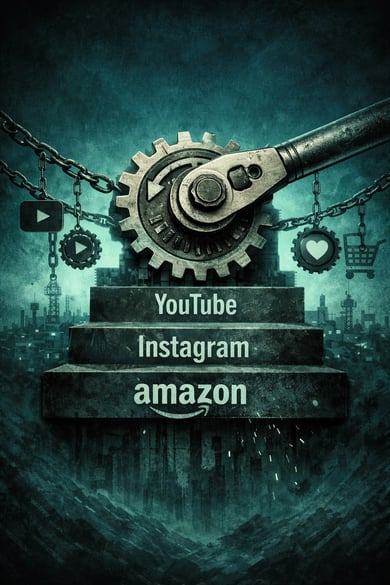
This pattern deserves a name. Call it the engagement ratchet. A platform extends algorithmic control into a space the user previously owned. Users protest. Engagement numbers improve. The change becomes permanent. In practice, the ratchet rarely turns back. Instagram never restored the chronological feed as the default. Every platform that followed drew the same conclusion.
Amazon's $2.5 Billion Lesson in How Far Is Too Far
The engagement ratchet operates on a spectrum. YouTube's subscription change sits at the subtle end. Amazon's Prime cancellation flow occupied the brazen end.
Amazon internally code named its Prime cancellation process the "Iliad Flow," after the epic poem about the decade long Trojan War (CHI 2025 proceedings). The name was fitting. The design was intentional. Four pages, six clicks, and fifteen different options stood between a user who wanted to cancel and actually cancelling. The interface used confirmshaming, labeling the decline button with language like "No thanks, I do not want fast, FREE delivery" (NPR, September 2025). It used misdirection, drawing the user's eye toward "Keep my benefits" with high contrast colors while burying "Continue to Cancel" in small, muted text. Researchers describe the overall pattern as a "roach motel," easy to enter and deliberately difficult to leave (UX Collective, 2025).
In September 2025, the FTC settled with Amazon for $2.5 billion, described by NPR as the largest consumer protection settlement in history, comprising $1 billion in civil penalties and $1.5 billion in consumer refunds. Amazon was required to simplify its cancellation flow to match the ease of enrollment and engage a third party supervisor to monitor compliance (NPR, September 2025).
The Iliad Flow and YouTube's subscription change look different on the surface. One is a labyrinthine cancellation gauntlet. The other is a single row of recommended videos. But the underlying mechanism is the same. Both substitute platform priorities for user choices. The difference is one of degree.
How Nudges Become Manipulation
The academic framework behind these design choices originates with Richard Thaler and Cass Sunstein, who defined the term "nudge" in their 2008 book of the same name. A nudge, as they defined it, is a change to the choice environment that steers behavior while preserving the person's freedom to choose otherwise. The canonical example is placing fruit at eye level in a cafeteria. The candy is still available. The architecture just makes the healthier option easier to reach.
That definition contains a critical constraint that platforms have quietly abandoned. A nudge preserves the ability to choose differently. A dark pattern removes it, or makes the alternative so costly that the choice becomes theoretical rather than real.
It is important to consider where YouTube's subscription change falls on this spectrum. The chronological feed still exists below the "most relevant" row. In a strict reading, the user's freedom to choose has been preserved. But the default has been altered. And defaults are the single most powerful tool in choice architecture. Research consistently shows that the vast majority of users accept whatever the default presents without modifying it.
When the design serves the user's stated interest, altering the default is a nudge. When it serves the platform's commercial interest at the expense of the user's stated interest, it crosses into manipulation. For the platform, the incentive is straightforward. If algorithmic curation lifts watch time, it likely lifts revenue as well. YouTube did not add the "most relevant" row because users were requesting it. Reddit threads confirm the opposite.
But revenue only explains part of why these systems keep expanding.
When the Infrastructure Serves More Than Advertisers
Between December 2022 and March 2023, internal Twitter documents released to independent journalists, including Matt Taibbi, Bari Weiss, and Michael Shellenberger, showed that federal agencies including the FBI and the Department of Homeland Security flagged social media content for the platform to review or deprioritize (Twitter Files, December 2022 through March 2023). Twitter's internal "visibility filtering" system could limit the reach of specific accounts or tweets without notifying the affected users. The mechanism is structurally similar to the algorithmic ranking YouTube now applies to its subscription page. Both determine what the user sees. Both operate without the user's explicit knowledge.
The legal and political interpretation of that coordination remains contested. The Supreme Court declined to reach the merits in *Murthy v. Missouri* (2024), ruling on standing grounds instead. But regardless of where one falls on the constitutional questions, the structural observation is relevant to the engagement ratchet. When a platform controls what appears in the user's feed by default, that infrastructure has applications beyond ad optimization. Platforms built it for engagement. The Twitter Files suggest it was also used for content moderation purposes by institutions outside the platform. That dual use capacity is worth keeping in mind as algorithmic curation extends into the last spaces users once controlled.
Where the Regulators Are and Where They Are Not
The regulatory landscape has started responding to the most egregious dark patterns but has not reached the subtler forms of nudge escalation.
The FTC finalized its "Click to Cancel" rule in October 2024, mandating that cancellation must be as easy as enrollment. The U.S. Court of Appeals for the Eighth Circuit vacated the rule in July 2025 on procedural grounds (Goodwin Law, February 2026). Despite the vacatur, the FTC continues enforcement under Section 5 of the FTC Act and the Restore Online Shoppers' Confidence Act. Recent enforcement actions against Uber, LA Fitness, and Chegg have challenged burdensome cancellation practices. A new Advance Notice of Proposed Rulemaking was submitted to the Office of Information and Regulatory Affairs in January 2026, signaling renewed intent (Goodwin Law, February 2026).
The EU Digital Services Act, in force since 2022, prohibits misleading interfaces and requires explicit user consent. Amazon's $2.5 billion settlement establishes that there is a legal line for subscription traps and deceptive cancellation flows.
But the gap between what is regulated and what is happening is significant. Current enforcement targets the most blatant patterns. Hidden fees. Subscription traps. Cancellation mazes. YouTube's subscription change violates none of these. No fee is hidden. No subscription is trapped. The user's feed still exists beneath the algorithmic row. The engagement ratchet operates below the regulatory threshold. Each individual turn is small enough to be legally defensible. The cumulative effect across platforms, a steady erosion of user agency that compounds over years, is what no single regulation addresses.
| Platform | What Changed | User Control Before | User Control After | Regulatory Response |
| Instagram (2016) | Chronological feed replaced with algorithmic ranking | Full (time ordered, user selected) | Partial (algorithm selects order) | None |
| Amazon (Prime) | Cancellation flow designed to obstruct departure | Theoretically full (cancel option existed) | Minimal (4 pages, 6 clicks, 15 options) | FTC settlement, $2.5B (Sept 2025) |
| Youtube (2025/2026) | "Most relevant" row added to subscription page | Full (chronological, user selected) | Partial (algorithm selects top row, no opt out reported) | None |
The Ratchet Rarely Turns Back
Major platforms have shown little willingness to restore user controlled defaults once algorithmic ranking takes hold. Instagram never returned to chronological. Amazon resisted for years until a $2.5 billion settlement forced the change. YouTube has offered no toggle. The engagement ratchet persists because it serves multiple interests simultaneously, generating revenue while building infrastructure that determines what users see by default. The regulatory gap between dark patterns, which are slowly becoming actionable, and subtler nudge escalation, which remains legal and profitable, is where the next meaningful contest will play out. The next time a platform changes what appears first in a space the user built, recognize the mechanism. The default is the product.
Sources:
- Register, Y., Qin, L., Baughan, A., and Spiro, E.S., "Attached to 'The Algorithm': Making Sense of Algorithmic Precarity on Instagram," ACM CHI 2023
- NPR, "The 'dark patterns' at the center of FTC's lawsuit against Amazon," September 23, 2025
- UX Collective, "The dark pattern that cost Amazon $2.5 billion," 2025
- CHI 2025 Proceedings, "Getting Trapped in Amazon's 'Iliad Flow': A Foundation for the Temporal Analysis of Dark Patterns," ACM, 2025
- Goodwin Law, "FTC's 'Click-to-Cancel' Rule Gets New Life As FTC's Enforcement Wave Continues to Target Negative-Option Sellers," February 2026
- FTC, "Click to Cancel: The FTC's amended Negative Option Rule and what it means for your business," October 2024
- Berkeley Technology Law Journal, "Trapped By Design: How Dark Patterns Manipulate Your Choices and the Regulators Fighting Back," November 2025
- Thaler, R.H. and Sunstein, C.R., "Nudge: Improving Decisions About Health, Wealth, and Happiness," Yale University Press, 2008
- YouTube Official Blog, "On YouTube's recommendation system"
- Reddit, r/youtube community threads on subscription page "most relevant" section changes, late 2025/early 2026
- Twitter Files, Taibbi, M., Weiss, B., Shellenberger, M., et al., released December 2022 through March 2023
- SCOTUSblog, "Justices side with Biden over government's influence on social media content moderation," June 26, 2024
- Murthy v. Missouri, 584 U.S. ___, No. 23-411 (2024)




.png)











.png)


-1.png)
.png)




.png)