Logo-300x300-colored-3
  • Home
  • Services
    • Offensive Security
    • Defensive Security
    • Privacy Engineering
    • AI Advisory
    • AI Assessment
    • AI Integration
  • Products
  • About
    • About Us
    • FAQ's
  • Resources
    • Blog
    • In The Media
    • Podcasts
    • All Resources
Get a Free Assessment
Back to Blog
MCP Security Credential Management AI Agents Non-Human-Identity Machine Identity

The Agent Identity Problem: Non-Human Identities Outnumber Humans 45 to 1 and AI Agents Are Making It Worse

Jacob Krell July 24, 2026 8 min read
Table of Contents

    The Agent Identity Problem: Non-Human Identities Outnumber Humans 45 to 1 and AI Agents Are Making It Worse

    At a Glance

    • Non-human identities already outnumber humans 45 to 1 in the average enterprise, and agentic AI is compounding that ratio faster than IAM teams can govern it.

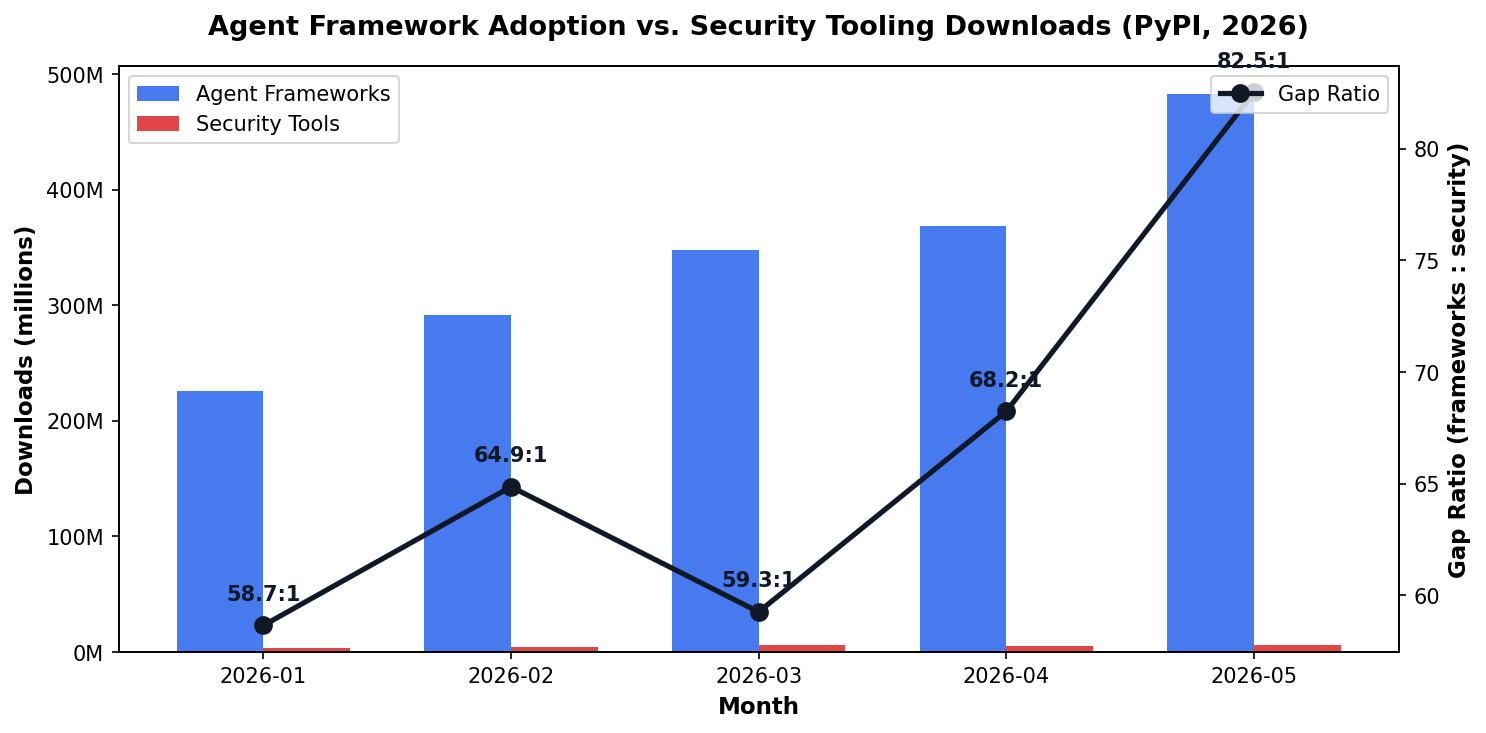
    • Agent framework downloads outpace security tooling 83 to 1 on PyPI, a gap that widened 41% between January and May 2026.

    • Ninety-two percent of organizations say their current IAM tools cannot manage AI agent identities.

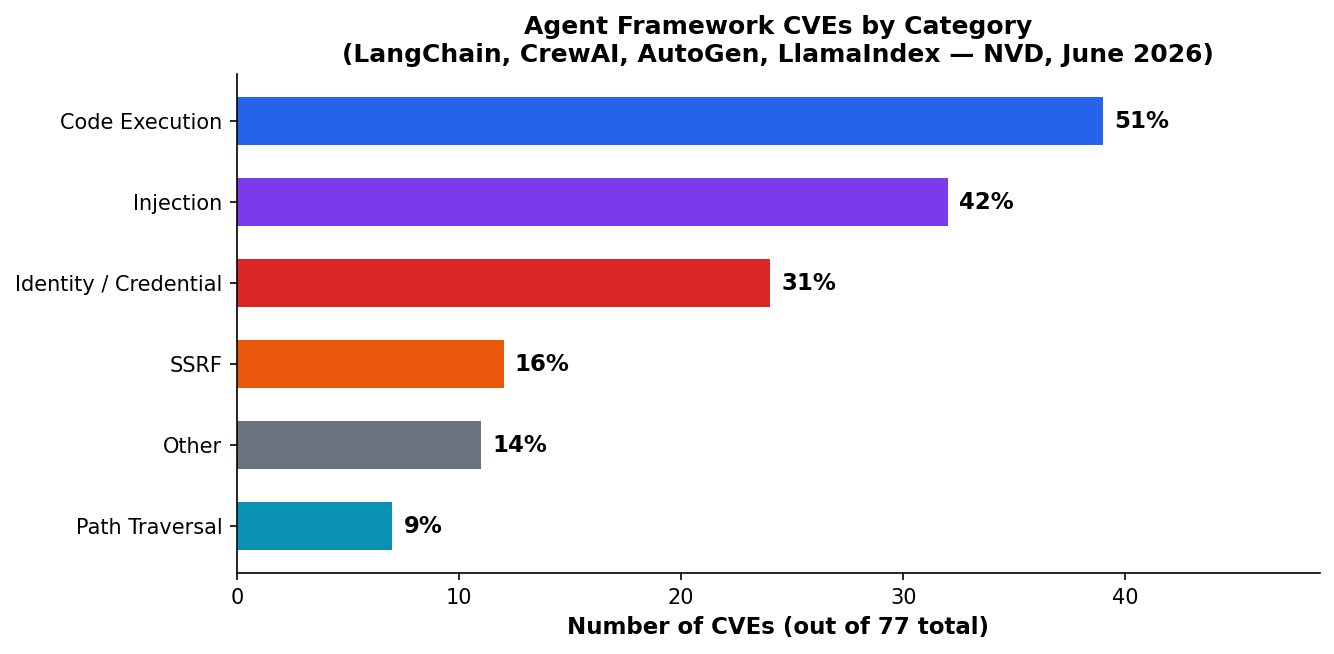
    • One in three agent framework CVEs involves identity, credential, or access control flaws, based on 77 CVEs analyzed from NVD.

    • Attackers exploit exposed AWS credentials within an average of 17 minutes, while nearly a quarter of organizations take over 24 hours to rotate them.

    • Sixty-four percent of secrets confirmed as exposed in 2022 remained valid four years later.

    • Forty percent of live Model Context Protocol (MCP) servers in a study of nearly 8,000 had zero authentication, and every OAuth-enabled server tested carried at least one flaw.


    Why Agents Break the Identity Model

    A service account sits in one system, holds one credential, does one job. An AI agent acquires permissions dynamically at runtime, spawns sub-agents, invokes external APIs, writes and executes code, and chains actions across dozens of systems in a single task. The blast radius of a compromised agent credential dwarfs what a static service account could produce, yet only 22% of security teams treat agents as independent identities.

    A 2026 survey from the Cloud Security Alliance (CSA) quantified the gap with numbers that should alarm any Identity and Access Management (IAM) team. Ninety-two percent of respondents said their legacy IAM tools cannot manage AI and NHI risks, and half reported no clear ownership or accountability for agent identities. A separate CSA survey found that only 28% of organizations can trace an agent's actions back to a human sponsor across all environments.

    These gaps are already being exploited. Nearly half of organizations have reported breaches involving non-human identities, and two-thirds have suffered successful cyberattacks from compromised NHIs. The Salesloft-Drift breach in August 2025 illustrated what this looks like in practice when the threat actor UNC6395 stole OAuth tokens from a single Drift integration and targeted Salesforce instances across over 700 potentially impacted organizations. No malware required, just token abuse at integration speed. Vercel's April 2026 breach ran the same play, with a compromised third-party OAuth integration exposing database secrets, signing keys, and customer credentials.

    Over-permissioning is the accelerant. A 2025 report from the Non-Human Identity Management Group (NHIMG) found that 73% of secrets held by NHIs carry excessive permissions, and over 5.5% of AWS machine identities have full administrative privileges. When an AI agent inherits or acquires a credential at that privilege level, the distance between "authorized to do its job" and "authorized to do anything" collapses to zero. OWASP's Agentic Security Initiative classifies this pattern under ASI03 (Identity and Privilege Abuse).

    The Adoption-Governance Gap, Measured

    We quantified the adoption-governance gap directly using PyPI download data. Agent framework packages, including LangChain, LangGraph, CrewAI, OpenAI Agents SDK, LlamaIndex, and PydanticAI among others, pulled 483 million downloads in May 2026. Agent security and guardrails packages pulled 5.8 million in the same month, an 83-to-1 ratio that reveals just how far deployment is outrunning governance.

    That ratio is widening. In January 2026 it was 59 to 1. By May, 83 to 1, a 41% increase in five months. Agent capability adoption is leaving security tooling further behind each month.
    adoption_governance_gap

    The Credential Lifecycle Gap

    GitGuardian's 2026 State of Secrets Sprawl report measured 28.65 million new hardcoded secrets in public GitHub commits in 2025, a 34% year-over-year increase. AI-assisted development is driving much of that growth. AI-service secrets surged 81% to 1.275 million exposed credentials, and Claude Code co-authored commits leaked secrets at roughly twice the baseline rate.

    MCP introduced a new exposure vector entirely. In the protocol's first year of adoption, 24,008 unique secrets appeared in MCP configuration files on public GitHub, partly because quickstart guides normalized hardcoding API keys directly into configuration files.

    The remediation side is where the gap becomes structural. GitGuardian retested secrets confirmed as valid in 2022 and found that 64% were still not revoked by January 2026, representing four years of exposure for credentials that should have been rotated within hours. The attacker-defender timing asymmetry makes this negligence lethal. When AWS credentials appear publicly, attackers attempt access within an average of 17 minutes, while nearly a quarter of organizations take more than 24 hours to rotate exposed credentials. That is an 85x speed gap working in the attacker's favor.

    Every AI agent deployed with a long-lived credential inherits that asymmetry.

    The Agent Identity Blast Radius Model

    Cross-referencing CSA, NHIMG, and ManageEngine data, we modeled what agent identity sprawl looks like for a 1,000-employee organization. The numbers compound fast. Only 12% of organizations have automated lifecycle management. The other 88% run on spreadsheets and hope.

    Step Calculation Result
    Total Employees Baseline 1,000
    NHI's at 45:1 ratio (CSA) 1,000 X 45 45,000
    NHI's with over-priveleged secrets (73%, NHIMG) 45,000 X 0.73 ~32,850
    Full admin access (5.5%,NHMIG) 45,000 X 0.055 ~2,475
    NHI's after 2 years at 44% YoY (Entro) 45,000 x 1.44² ~93,312
    Governed by automation (12%) 93,312 X 0.12 ~11,197
    Manually managed (88%) 93,312 X 0.88 ~82,115


    AI agents compound the sprawl because each agent deployed with enterprise credentials creates new OAuth grants, API tokens, and service accounts. Spawned sub-agents inherit or escalate those credentials, and every MCP server connection introduces an authentication surface that most organizations have not evaluated.

    A measurement study of 7,973 live remote MCP servers found that 40% had no authentication at all. The servers that did implement OAuth fared little better, with every single one of the 119 OAuth-enabled servers tested carrying at least one authentication flaw. Dynamic client registration vulnerabilities affected 96.6%, and the researchers obtained 9 CVEs from the study.

    Agent frameworks themselves carry identity vulnerabilities baked into the code that organizations are deploying at scale. Analysis of 77 CVEs across LangChain, CrewAI, AutoGen, and LlamaIndex shows that 32% involve identity, credential, or access control flaws, and 73% of all agent framework CVEs are rated CRITICAL or HIGH. Q1 2026 set a record with 14 agent framework CVEs in a single quarter.
    cve_category_breakdown

    A single MCP server connecting an AI agent to a production database with hardcoded credentials, no authentication, and no scoping is the default configuration.

    The Regulatory Response vs. Reality

    NIST's National Cybersecurity Center of Excellence and the Coalition for Secure AI both published agent identity guidance in early 2026, and the direction is consistent. Agents need first-class identities with zero-standing privilege, short-lived credentials, and code-bound attestation. Ninety-two percent of organizations told the CSA their IAM tools cannot deliver it. Agent deployment is not waiting for IAM teams to catch up.

    What Organizations Should Do Now

    Kill long-lived agent credentials. Every AI agent should receive short-lived, task-scoped tokens through a credential broker or gateway. The credential expires when the task completes. Sub-agent credentials should be scoped more narrowly than the parent's, never equal.

    Treat MCP servers as a first-class attack surface. Forty percent have no authentication. OAuth 2.1 is the minimum, with per-tool authorization and human-in-the-loop approval for destructive actions.

    Measure credential lifecycle speed. If revoking a compromised agent credential takes days, the organization operates 85x slower than the attacker who exploited it within minutes. Automated revocation triggered by exposure detection is the target state.

    Identity governance spent decades solving for humans. Humans are now the minority of the identity population. AI agents will push the ratio from 45 to 1 to numbers the current IAM architecture was never designed to hold. Organizations that extend governance to agents will contain the blast radius. Those still running on legacy IAM will find out what an unmanaged agent credential can do at machine speed.


    Sources

    • Cloud Security Alliance, "State of Non-Human Identity and AI Security Survey Report," 2026

    • Cloud Security Alliance, "The Non-Human Identity Governance Vacuum," CSA Labs whitepaper, May 2026

    • Cloud Security Alliance, "Agent Identity Governance Framework," CSA Labs, 2026

    • Cloud Security Alliance / Strata Identity, "Securing Autonomous AI Agents," survey report, February 2026

    • ESG / Oasis Security, "2024 ESG Report: Managing Non-Human Identities"

    • NHIMG / Entro Security, "2025 State of Non-Human Identities and Secrets"

    • NHIMG / Entro Security, "NHI & Secrets Risk Report, H1 2025"

    • ManageEngine, "Identity Security Outlook 2026," January 2026

    • GitGuardian, "State of Secrets Sprawl 2026," March 2026

    • NIST NCCoE, "Accelerating the Adoption of Software and AI Agent Identity and Authorization," concept paper, February 2026

    • Coalition for Secure AI (CoSAI), "Agentic Identity and Access Management," March 2026

    • Token Security, "The 2026 DBIR Confirms It: Identity Is the Control Plane for Agentic AI," 2026

    • OWASP Top 10 for Agentic Applications, ASI03 (Identity and Privilege Abuse), 2026

    • Google Threat Intelligence Group (GTIG), "Widespread Data Theft Targets Salesforce Instances via Salesloft Drift," August 2025

    • Zhou et al., "A First Measurement Study on Authentication Security in Real-World Remote MCP Servers," arXiv:2605.22333, 2026

    • PyPI Stats API, package download data queried June 2026

    • NVD API, CVE data for agent frameworks queried June 2026


    Share
    Tags: MCP Security Credential Management AI Agents Non-Human-Identity Machine Identity
    Jacob Krell
    Jacob Krell

    Jacob Krell builds systems that are hard to break and breaks systems that appear resilient. He is an offensive security leader specializing in advanced penetration testing and red teaming across cloud, web, mobile, Active Directory, and AI-enabled environments, helping organizations expose real-world risk and validate their defenses against modern adversaries. In parallel, he is a full-stack software engineer who develops custom cybersecurity tooling, intelligent automation platforms, and production-grade applications that embed security directly into the technology lifecycle. Ranked 25th globally on Hack The Box with more than 1,000 flags captured and holding many elite certifications, including OSCE3, CISSP, OSCP, CCNP Security, and CSIE, Jacob combines hands-on technical depth with the ability to translate complex cyber risk into clear business strategy.

    Stay ahead of the threat landscape

    AI security insights, threat intelligence, and research from our team. No spam, unsubscribe anytime.

    Subscribe
    ← Previous CMMC's Third-Party Assessments Are Paused. The Standard of Care Isn't

    Latest Posts

    View All
    The Agent Identity Problem: Non-Human Identities Outnumber Humans 45 to 1 and AI Agents Are Making It Worse
    MCP Security
    Jul 24, 2026 Jacob Krell

    The Agent Identity Problem: Non-Human Identities Outnumber Humans 45 to 1 and AI Agents Are Making It Worse

    The Agent Identity Problem: Non-Human Identities Outnumber Humans 45 to 1 and AI Agents Are Making It Worse At a Glance ...

    Read More: The Agent Identity Problem: Non-Human Identities Outnumber Humans 45 to 1 and AI Agents Are Making It Worse
    CMMC's Third-Party Assessments Are Paused. The Standard of Care Isn't
    Government Security
    Jul 20, 2026 Denis Calderone

    CMMC's Third-Party Assessments Are Paused. The Standard of Care Isn't

    On July 13 the Department of War suspended Phase 2 of CMMC, the third party certification requirement that was set to ...

    Read More: CMMC's Third-Party Assessments Are Paused. The Standard of Care Isn't
    The Training Tax
    AI Economics
    Jul 20, 2026 Jacob Krell

    The Training Tax

    At a Glance Training is a one-time bill. Inference compounds.GPT-4 cost over $100M to train. Serving GPT-4o at ...

    Read More: The Training Tax
    Why Mobile Applications Need Real Penetration Testing
    Cybersecurity
    Jul 20, 2026 Suzu Labs

    Why Mobile Applications Need Real Penetration Testing

    Mobile applications have become a primary interface between organizations and their customers, handling everything from ...

    Read More: Why Mobile Applications Need Real Penetration Testing
    Cloud Security Means More Than Securing the Cloud
    Penetration Testing
    Jul 16, 2026 Suzu Labs

    Cloud Security Means More Than Securing the Cloud

    As organizations connect more IoT devices to cloud platforms, the attack surface expands well beyond the device itself. ...

    Read More: Cloud Security Means More Than Securing the Cloud
    Third-Party Risks: When Trusted Connections Become Attack Paths
    Penetration Testing
    Jul 16, 2026 Suzu Labs

    Third-Party Risks: When Trusted Connections Become Attack Paths

    Modern applications rarely operate alone. They rely on API gateways, webhooks, cloud services, SaaS platforms, and ...

    Read More: Third-Party Risks: When Trusted Connections Become Attack Paths
    VPNs Aren't the Risk. The Network Paths Around Them Are.
    Cybersecurity
    Jul 14, 2026 Suzu Labs

    VPNs Aren't the Risk. The Network Paths Around Them Are.

    Virtual Private Networks (VPNs) remain one of the most common ways organizations provide secure remote access to ...

    Read More: VPNs Aren't the Risk. The Network Paths Around Them Are.
    Top 7 AI Security Risks in 2026
    Cybersecurity
    Jul 10, 2026 Hannah Perez

    Top 7 AI Security Risks in 2026

    Quick guide: 7 AI security risks every CISO should know Data poisoning: Attackers corrupt training datasets to ...

    Read More: Top 7 AI Security Risks in 2026
    Pipeline Security Testing: Securing Your Software Supply Chain
    Penetration Testing
    Jul 09, 2026 Suzu Labs

    Pipeline Security Testing: Securing Your Software Supply Chain

    Modern development teams rely on CI/CD pipelines to build, test, and deploy software faster than ever before. But the ...

    Read More: Pipeline Security Testing: Securing Your Software Supply Chain
    Understanding API Risk: Focus on What Attackers Actually Use
    Penetration Testing
    Jul 08, 2026 Suzu Labs

    Understanding API Risk: Focus on What Attackers Actually Use

    Application Programming Interfaces (APIs) have become the backbone of modern software. They connect web applications, ...

    Read More: Understanding API Risk: Focus on What Attackers Actually Use
    Enterprise AI Security Solutions for Mid-Sized Tech 2026
    AI Security
    Jul 08, 2026 Hannah Perez

    Enterprise AI Security Solutions for Mid-Sized Tech 2026

    Finding the Right AI Security Partner for Your Growing Tech Company Your engineering team just deployed a new ...

    Read More: Enterprise AI Security Solutions for Mid-Sized Tech 2026
    MFA Gaps: Why Strong Authentication Doesn't Always Mean Strong Security
    MFA
    Jul 06, 2026 Suzu Labs

    MFA Gaps: Why Strong Authentication Doesn't Always Mean Strong Security

    Multi-factor authentication (MFA) has become a foundational security control, and for good reason. It significantly ...

    Read More: MFA Gaps: Why Strong Authentication Doesn't Always Mean Strong Security
    Understanding Application Attack Paths: Beyond the Vulnerability List
    Penetration Testing
    Jul 03, 2026 Suzu Labs

    Understanding Application Attack Paths: Beyond the Vulnerability List

    Modern web applications are made up of countless interactions between users, APIs, databases, and third-party services. ...

    Read More: Understanding Application Attack Paths: Beyond the Vulnerability List
    AI Jailbreaking: Finding the Gaps Before Attackers Do
    Cybersecurity
    Jul 01, 2026 Suzu Labs

    AI Jailbreaking: Finding the Gaps Before Attackers Do

    As organizations rapidly integrate large language models into customer-facing applications, internal tools, and ...

    Read More: AI Jailbreaking: Finding the Gaps Before Attackers Do
    Understanding Attack Paths: Seeing Security the Way an Attacker Does
    Penetration Testing
    Jul 01, 2026 Suzu Labs

    Understanding Attack Paths: Seeing Security the Way an Attacker Does

    When a security incident occurs, an audit identifies gaps, or your organization introduces new applications, cloud ...

    Read More: Understanding Attack Paths: Seeing Security the Way an Attacker Does
    The AI Industry's Prescott Moment
    LLM
    Jun 30, 2026 Jacob Krell

    The AI Industry's Prescott Moment

    Intel killed its fastest chip in 2004 because clock speed had become the wrong metric. AI is approaching the same ...

    Read More: The AI Industry's Prescott Moment
    The Kylie Effect: How Meta Just Normed the Smart Glasses Privacy Dilemma
    Data Privacy
    Jun 30, 2026 Hannah Perez

    The Kylie Effect: How Meta Just Normed the Smart Glasses Privacy Dilemma

    When tech companies first tried to put cameras on our faces, the public reaction was loud, clear, and overwhelmingly ...

    Read More: The Kylie Effect: How Meta Just Normed the Smart Glasses Privacy Dilemma
    The Extortion Market Has Matured, And the Response Industry Is Part of It
    Threat Intelligence
    Jun 25, 2026 Denis Calderone

    The Extortion Market Has Matured, And the Response Industry Is Part of It

    In May, a criminal extortion group told 9,000 schools to hire breach coaches and negotiate ransom payments ...

    Read More: The Extortion Market Has Matured, And the Response Industry Is Part of It
    The ICS Exploit Pipeline Is Built for Destruction, Not Theft
    Vulnerability Management
    Jun 22, 2026 Jacob Krell

    The ICS Exploit Pipeline Is Built for Destruction, Not Theft

    The vulnerability pipeline feeding ICS attackers is structurally optimized for breaking infrastructure, not stealing ...

    Read More: The ICS Exploit Pipeline Is Built for Destruction, Not Theft
    973 MCP Packages, 71% Single-Maintainer: A Practitioner's Guide to AI Developer Security
    Prompt Injection
    Jun 17, 2026 Jacob Krell

    973 MCP Packages, 71% Single-Maintainer: A Practitioner's Guide to AI Developer Security

    At a Glance AI security tooling adoption lags behind AI coding tool adoption by an order of magnitude. Download ratios: ...

    Read More: 973 MCP Packages, 71% Single-Maintainer: A Practitioner's Guide to AI Developer Security
    The AI Governance Gap: Verizon's 2026 DBIR Shows Attackers Scaling AI While Employees Leak Data Through It
    AI Governance
    May 28, 2026 Jacob Krell

    The AI Governance Gap: Verizon's 2026 DBIR Shows Attackers Scaling AI While Employees Leak Data Through It

    On May 20, 2026, Verizon published the 2026 Data Breach Investigations Report with a dedicated AI section built on ...

    Read More: The AI Governance Gap: Verizon's 2026 DBIR Shows Attackers Scaling AI While Employees Leak Data Through It
    The Remediation Paradox: Verizon's 2026 DBIR Shows Exploitation Winning While Defenders Patch Slower
    Mean Time to Exploit
    May 21, 2026 Jacob Krell

    The Remediation Paradox: Verizon's 2026 DBIR Shows Exploitation Winning While Defenders Patch Slower

    On May 20, 2026, Verizon published the [2026 Data Breach Investigations ...

    Read More: The Remediation Paradox: Verizon's 2026 DBIR Shows Exploitation Winning While Defenders Patch Slower
    The Extension Blind Spot: How One VS Code Plugin Gave Attackers GitHub's Source Code
    Cybersecurity
    May 20, 2026 Jacob Krell

    The Extension Blind Spot: How One VS Code Plugin Gave Attackers GitHub's Source Code

    GitHub's 3,800 Repositories Stolen Through a Single IDE Extension On May 19, 2026, a single VS Code extension on a ...

    Read More: The Extension Blind Spot: How One VS Code Plugin Gave Attackers GitHub's Source Code
    The Cost of a Click: Why Passive Cookie Consent Is Your Biggest Compliance Liability
    May 20, 2026 Hannah Perez

    The Cost of a Click: Why Passive Cookie Consent Is Your Biggest Compliance Liability

    If you think a basic pop-up banner that reads "By continuing to browse this site, you accept cookies" protects your ...

    Read More: The Cost of a Click: Why Passive Cookie Consent Is Your Biggest Compliance Liability
    Five Years of US Privacy Breach Data Tell a Story Security Leaders Cannot Ignore
    Data Privacy
    May 19, 2026 Jacob Krell

    Five Years of US Privacy Breach Data Tell a Story Security Leaders Cannot Ignore

    In April 2026 alone, the ShinyHunters extortion group breached ADT (5.5 million customers), Amtrak (2.1 million ...

    Read More: Five Years of US Privacy Breach Data Tell a Story Security Leaders Cannot Ignore
    Mean Time to Exploit Has Gone Negative. Security Strategy Has to Change.
    Vulnerability Management
    May 05, 2026 Jacob Krell

    Mean Time to Exploit Has Gone Negative. Security Strategy Has to Change.

    Mandiant's M-Trends 2026 report puts estimated mean time to exploit at negative seven days. That number should reset ...

    Read More: Mean Time to Exploit Has Gone Negative. Security Strategy Has to Change.
    When AI Billing Breaks Trust: What the Claude Code Backlash Says About AI Governance
    Prompt Injection
    Apr 30, 2026 Hannah Perez

    When AI Billing Breaks Trust: What the Claude Code Backlash Says About AI Governance

    When AI Billing Breaks Trust: Lessons from the Claude Code Backlash AI adoption is accelerating, but trust is still ...

    Read More: When AI Billing Breaks Trust: What the Claude Code Backlash Says About AI Governance
    From Army Ranger to Ethical Hacker: What Cybersecurity Can Learn from the Battlefield
    Cybersecurity
    Apr 29, 2026 Suzu Labs

    From Army Ranger to Ethical Hacker: What Cybersecurity Can Learn from the Battlefield

    Cybersecurity doesn’t start with tools, it starts with mindset. In this episode featuring Aaron Colclough, we get a ...

    Read More: From Army Ranger to Ethical Hacker: What Cybersecurity Can Learn from the Battlefield
    When Elite Cyber Teams Can't Crack Web Security
    Cybersecurity
    Apr 23, 2026 Jacob Krell

    When Elite Cyber Teams Can't Crack Web Security

    HTB's 2025 benchmark tested 796 security teams. Only 21% passed web security challenges. The Security Illusion Security ...

    Read More: When Elite Cyber Teams Can't Crack Web Security
    The Invisible Threat: Business Logic Flaws in Modern Applications and Why Scanners Miss Them
    Cybersecurity
    Apr 22, 2026 Jacob Krell

    The Invisible Threat: Business Logic Flaws in Modern Applications and Why Scanners Miss Them

    In today's security landscape, some of the most dangerous vulnerabilities aren't flagged by automated scanners at all. ...

    Read More: The Invisible Threat: Business Logic Flaws in Modern Applications and Why Scanners Miss Them
    Suzu Labs Acquires Emulated Criminals
    Apr 20, 2026 Hannah Perez

    Suzu Labs Acquires Emulated Criminals

    Bridging the gap between theory and the threat reality, Suzu Labs is proud to announce the acquisition of Emulated ...

    Read More: Suzu Labs Acquires Emulated Criminals
    The Wall Around Claude 4.7 Does Not Extend to Dread
    Cybersecurity
    Apr 17, 2026 Suzu Labs

    The Wall Around Claude 4.7 Does Not Extend to Dread

    Anthropic released Claude Opus 4.7 on April 16, 2026 with automated cybersecurity safeguards and a Cyber Verification ...

    Read More: The Wall Around Claude 4.7 Does Not Extend to Dread
    The Engagement Ratchet: How YouTube, Instagram, and Amazon Trained Users to Accept Less Control
    youtube
    Apr 10, 2026 Jacob Krell

    The Engagement Ratchet: How YouTube, Instagram, and Amazon Trained Users to Accept Less Control

    Earlier this year, YouTube began rolling out a row of algorithmically recommended videos at the top of the ...

    Read More: The Engagement Ratchet: How YouTube, Instagram, and Amazon Trained Users to Accept Less Control
    The AI Revolution: How Jobs Will Change by 2030
    Cybersecurity
    Apr 07, 2026 Suzu Labs

    The AI Revolution: How Jobs Will Change by 2030

    Host Phillip Wylie sits down with Nicolas Chaillan to discuss the sobering reality of AI replacement, the critical need ...

    Read More: The AI Revolution: How Jobs Will Change by 2030
    The Rosie Protocol: Is AI-Driven Personalized Medicine Finally Here?
    Generative AI
    Apr 01, 2026 Hannah Perez

    The Rosie Protocol: Is AI-Driven Personalized Medicine Finally Here?

    In late 2024, Sydney tech entrepreneur Paul Conyngham was told his rescue dog, Rosie, had months to live. She was ...

    Read More: The Rosie Protocol: Is AI-Driven Personalized Medicine Finally Here?
    From Analog Hacks to Agentic AI: The Evolution of Offensive Security with Denis Calderone
    Cybersecurity
    Mar 30, 2026 Suzu Labs

    From Analog Hacks to Agentic AI: The Evolution of Offensive Security with Denis Calderone

    The world of cybersecurity has undergone a massive transformation in just a few decades. In this episode of Simply ...

    Read More: From Analog Hacks to Agentic AI: The Evolution of Offensive Security with Denis Calderone
    While TSA Made Headlines, CISA Went Dark
    Critical Infrastructure
    Mar 30, 2026 Jacob Krell

    While TSA Made Headlines, CISA Went Dark

    The Department of Homeland Security has been partially shut down for over 45 days. In that time, 460 TSA officers have ...

    Read More: While TSA Made Headlines, CISA Went Dark
    The Purple Team Advantage: Bridging the Gap Between Hacking and Management with Chris Marks
    AI Security
    Mar 30, 2026 Suzu Labs

    The Purple Team Advantage: Bridging the Gap Between Hacking and Management with Chris Marks

    In cybersecurity, we often operate in silos. The red team breaks things, the blue team fixes them, and management ...

    Read More: The Purple Team Advantage: Bridging the Gap Between Hacking and Management with Chris Marks
    Claude Mythos and the Cybersecurity Risk That Was Already Here
    Threat Intelligence
    Mar 27, 2026 Jacob Krell

    Claude Mythos and the Cybersecurity Risk That Was Already Here

    On March 26, Anthropic confirmed the existence of Claude Mythos, an unreleased AI model described internally as "a step ...

    Read More: Claude Mythos and the Cybersecurity Risk That Was Already Here
    BPFdoor in Telecom Networks: The FCC Is Securing the Edge, but China's Hackers Are Already Past It
    Critical Infrastructure
    Mar 26, 2026 Mike Bell

    BPFdoor in Telecom Networks: The FCC Is Securing the Edge, but China's Hackers Are Already Past It

    Rapid7's research reveals China-linked kernel implants deep inside telecom signaling infrastructure. Here's what ...

    Read More: BPFdoor in Telecom Networks: The FCC Is Securing the Edge, but China's Hackers Are Already Past It
    Securing the AI Frontier: Suzu Labs Sweeps 4 Global InfoSec Awards 2026
    Cybersecurity
    Mar 23, 2026 Hannah Perez

    Securing the AI Frontier: Suzu Labs Sweeps 4 Global InfoSec Awards 2026

    We are incredibly proud to announce a monumental achievement. At this year’s Global InfoSec Awards 2026, hosted by ...

    Read More: Securing the AI Frontier: Suzu Labs Sweeps 4 Global InfoSec Awards 2026
    From Cockpits to Code: Josh Mason on Bridging the Gap Between Military and Cybersecurity
    Cybersecurity
    Mar 17, 2026 Suzu Labs

    From Cockpits to Code: Josh Mason on Bridging the Gap Between Military and Cybersecurity

    In the world of cybersecurity, we often talk about "gatekeeping" or the "skills gap," but rarely do we find individuals ...

    Read More: From Cockpits to Code: Josh Mason on Bridging the Gap Between Military and Cybersecurity
    Simply Offensive Podcast: The Future of Pentesting: AI, Automation, and Better Reporting with Dan DeCloss
    Cybersecurity
    Mar 16, 2026 Phillip Wylie

    Simply Offensive Podcast: The Future of Pentesting: AI, Automation, and Better Reporting with Dan DeCloss

    The Future of Pentesting: AI, Automation, and Better Reporting with Dan DeCloss In this episode of Simply Offensive, ...

    Read More: Simply Offensive Podcast: The Future of Pentesting: AI, Automation, and Better Reporting with Dan DeCloss
    From Silence to Strike: Tracking Iran's Cyber Escalation in Real Time
    Critical Infrastructure
    Mar 13, 2026 Denis Calderone

    From Silence to Strike: Tracking Iran's Cyber Escalation in Real Time

    On March 12, medical technology giant Stryker confirmed a cyberattack that wiped devices across 79 countries. The ...

    Read More: From Silence to Strike: Tracking Iran's Cyber Escalation in Real Time
    Internal Analysis: Even Realities G2 Smart Glasses Security & Privacy Investigation
    Social Engineering
    Mar 09, 2026 Suzu Labs Intelligence

    Internal Analysis: Even Realities G2 Smart Glasses Security & Privacy Investigation

    Executive Summary Even Realities markets its G2 smart glasses as the privacy-conscious alternative to Meta Ray-Bans. ...

    Read More: Internal Analysis: Even Realities G2 Smart Glasses Security & Privacy Investigation
    The Company Reviewing Your Meta Glasses Footage Has a Security Problem
    Threat Intelligence
    Mar 06, 2026 Mike Bell

    The Company Reviewing Your Meta Glasses Footage Has a Security Problem

    Last week, Swedish journalists revealed that Meta sends video footage from Meta Ray-Ban smart glasses to human data ...

    Read More: The Company Reviewing Your Meta Glasses Footage Has a Security Problem
    The Death of the CTF: How Agentic AI Is Reshaping Competitive Hacking
    CTF
    Mar 03, 2026 Jacob Krell

    The Death of the CTF: How Agentic AI Is Reshaping Competitive Hacking

    View White Paper Abstract: Agentic AI systems are compressing competitive hacking timelines faster than the ...

    Read More: The Death of the CTF: How Agentic AI Is Reshaping Competitive Hacking
    Simply Offensive Podcast: AI Killed the CTF Star with Jacob Krell
    Cybersecurity
    Mar 03, 2026 Phillip Wylie

    Simply Offensive Podcast: AI Killed the CTF Star with Jacob Krell

    In this thought-provoking episode of Simply Offensive, host Philip Wylie sits down with Jacob Krell, a penetration ...

    Read More: Simply Offensive Podcast: AI Killed the CTF Star with Jacob Krell
    Anthropic and Claude: 2026 AI Powerhouse
    Supply Chain Security
    Feb 26, 2026 Hannah Perez

    Anthropic and Claude: 2026 AI Powerhouse

    In early 2026, the image of Anthropic as a cautious, safety-oriented "research lab" has effectively been replaced by ...

    Read More: Anthropic and Claude: 2026 AI Powerhouse
    Simply Offensive Podcast: Navigating AI's Challenges in Problem Solving with Darius Houle
    Cybersecurity
    Feb 24, 2026 Phillip Wylie

    Simply Offensive Podcast: Navigating AI's Challenges in Problem Solving with Darius Houle

    In this episode of Simply Offensive, host Philip Wylie welcomes Darius Houle, an Application Security (AppSec) and ...

    Read More: Simply Offensive Podcast: Navigating AI's Challenges in Problem Solving with Darius Houle
    Logo copy 3-1

    Fortified Security. Intelligent Innovation.

    +1 (702) 766-6257
    P.O. Box 750111
    Las Vegas, Nevada 89136

    Follow Us

    About

    • About Us
    • Contact
    • FAQ's

    Solutions

    • AI Advisory
    • AI Assessment
    • Offensive Security
    • Defensive Security
    • Privacy Engineering
    • Adversarial Operations
    • Social Engineering
    • Products

    Resources

    • Blog
    • In The Media
    • Podcasts
    © 2026 All rights reserved.
    • Privacy Policy
    • Terms & Conditions