Logo-300x300-colored-3
  • Home
  • Services
    • Offensive Security
    • Defensive Security
    • Privacy Engineering
    • AI Advisory
    • AI Assessment
    • AI Integration
  • Products
  • About
    • About Us
    • FAQ's
  • Resources
    • Blog
    • In The Media
    • Podcasts
    • All Resources
Get a Free Assessment
Back to Blog
LLM Open Source AI AI Infrastructure AI Economics

The AI Industry's Prescott Moment

Jacob Krell June 30, 2026 8 min read
Table of Contents

    Intel killed its fastest chip in 2004 because clock speed had become the wrong metric. AI is approaching the same inflection. For the majority of commercial applications, compute efficiency is the bottleneck. The industry is pouring billions into the wrong side of that equation.

    At a Glance

    • Suzu Labs analysis of the Hugging Face API (June 2026) shows 96% of text-generation model downloads go to models with 13B parameters or fewer. Not because practitioners want weaker models. Because those are the ones they can actually run.

    • Zero models above 70B parameters appear in the top 200 most-downloaded text-generation models.

    • A frontier-class model (estimated 1.8 trillion parameters) needs roughly 150x the VRAM of the best consumer GPU. Even quantized to 4-bit, a 70B model exceeds the RTX 5090's 32 GB ceiling.

    • bitsandbytes (quantization) and vllm (inference optimization) pull 6.4 million and 5.4 million PyPI downloads per month, respectively. Demand for deployment and optimization tooling is surging.

    • Every 2x reduction in inference cost expands the set of problems AI can economically solve. That math will drive the next decade more than any benchmark score.

    The Problem That Matters

    GPT-4 can write code, pass bar exams, and reason through multi-step problems. Claude and Gemini match it on most benchmarks. For customer support, document analysis, code generation, enterprise search, and dozens of other commercial workloads, the model crossed "good enough" sometime in 2024.

    Frontier research still matters. Autonomous robotics, drug discovery, and novel scientific reasoning are nowhere near solved. But those are a fraction of the commercial AI market. The vast majority of organizations deploying AI today are constrained by the cost of running models, not by the capability of the models themselves.

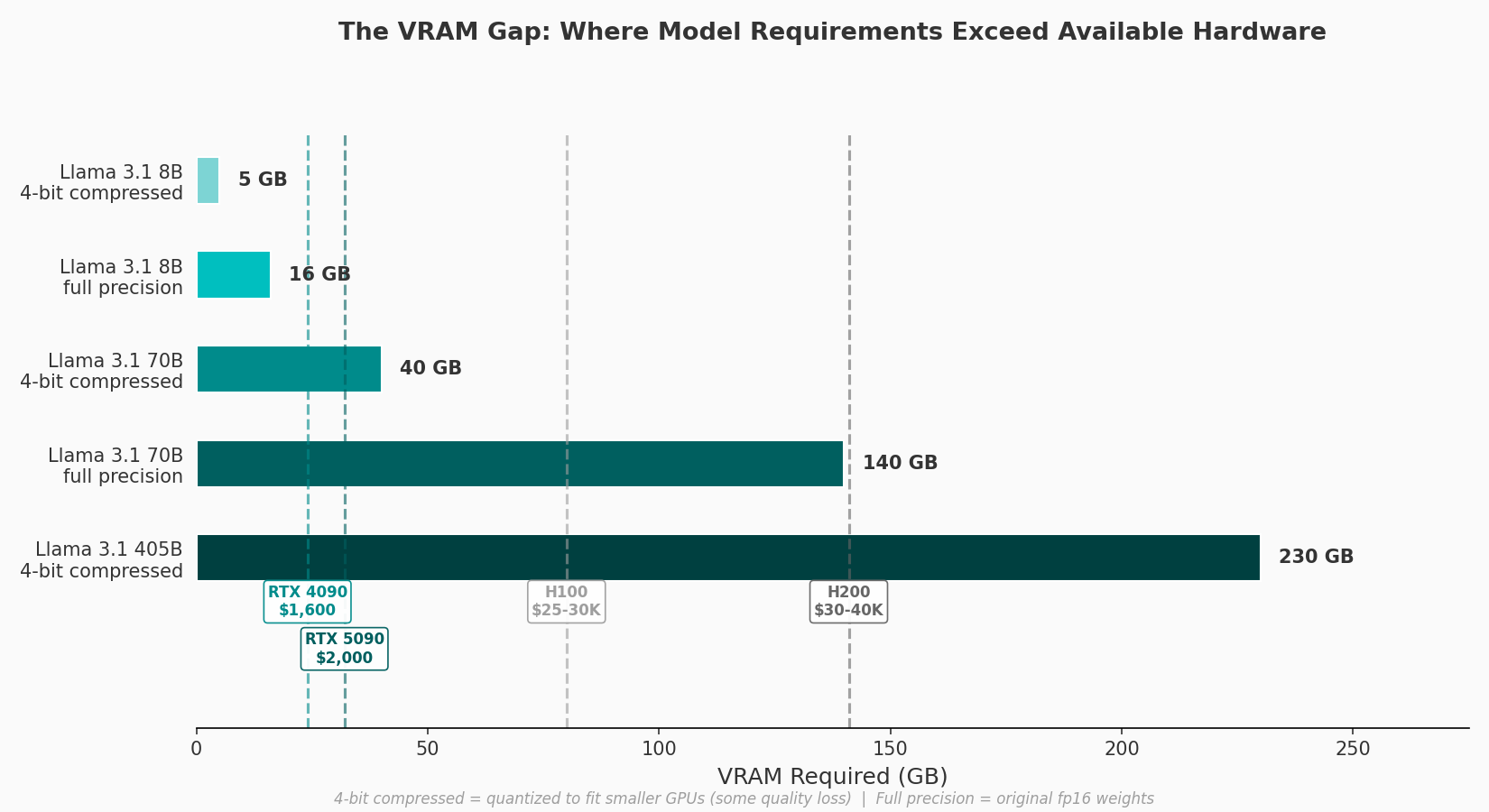
    Running a frontier-class model at 1.8 trillion parameters requires roughly 3,600 GB of VRAM at fp16 precision. An NVIDIA RTX 4090, the best consumer GPU at $1,600, has 24 GB.

    A 150x gap.

    Quantization narrows it but does not close it. At 4-bit precision, a 405B model still needs 230 GB (ten times a consumer GPU) and a 70B model needs 40 GB (more than the RTX 5090's 32 GB ceiling). Making the model bigger only makes the math worse.

    Cost mirrors the physics. Renting an H100 from a cloud provider runs $2-3 per hour. API inference on GPT-4-class models costs $10-30 per million output tokens. The entire cloud inference market exists because the compute bottleneck forces practitioners to rent hardware they cannot afford to own.

    A SaaS company routing 5,000 customer conversations a day through a frontier API spends $1,000-2,500 per month on inference. Running the same workload on a fine-tuned 7B model with a $1,600 RTX 4090 costs electricity. The 7B is good enough for the task. Compute access, not capability, is the gate.

    The Prescott Parallel

    Intel solved this problem twenty years ago by first making it worse.

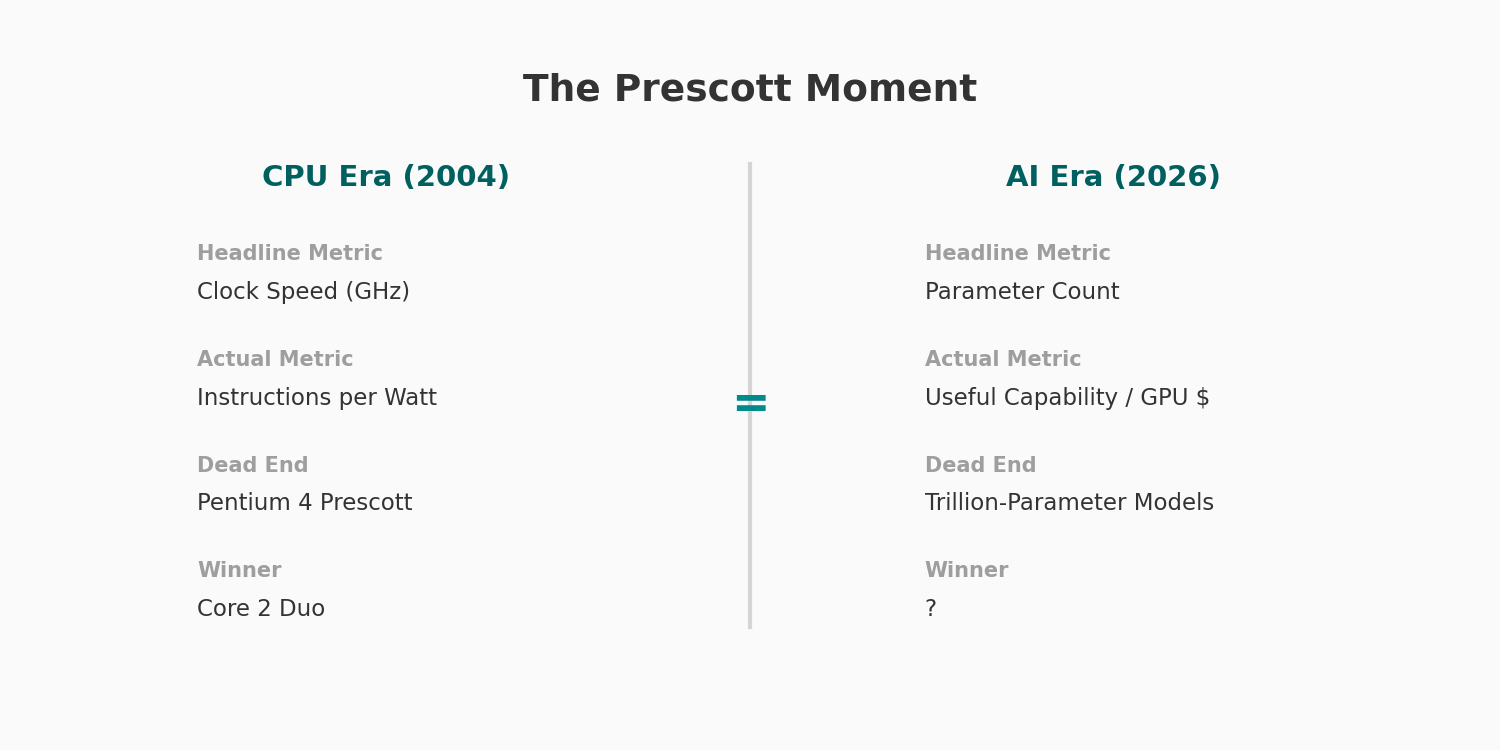
    In 2000, Intel shipped the Pentium 4 on the Netburst architecture, designed to push clock speed as high as possible. By 2004, Prescott hit 3.8 GHz and consumed 115 watts. The chip wasted cycles on a deep pipeline that inflated frequency at the expense of useful work per clock. Intel cancelled the planned 4 GHz SKU.

    Power and heat made the headlines, but compute efficiency was the actual failure. AMD's Athlon 64 won real-world benchmarks at lower clock speeds because it executed more useful instructions per cycle. Measured by Intel's marketing metric, the faster chip was doing less useful work.

    Core 2 Duo launched in 2006 at 2.66 GHz and 65 watts. It beat Prescott across every workload by optimizing for useful compute per cycle. Clock speed dropped 30%, performance rose 24%.
    prescott_moment

    Frontier labs invest in efficiency: OpenAI ships GPT-4o mini, Meta open-sources Llama, Google optimizes serving infrastructure. But the headline narrative and the billions in fundraising still point at raw scale. Parameter count climbs. The pool of people who can afford to run the product shrinks.

    The Market Already Made Its Choice

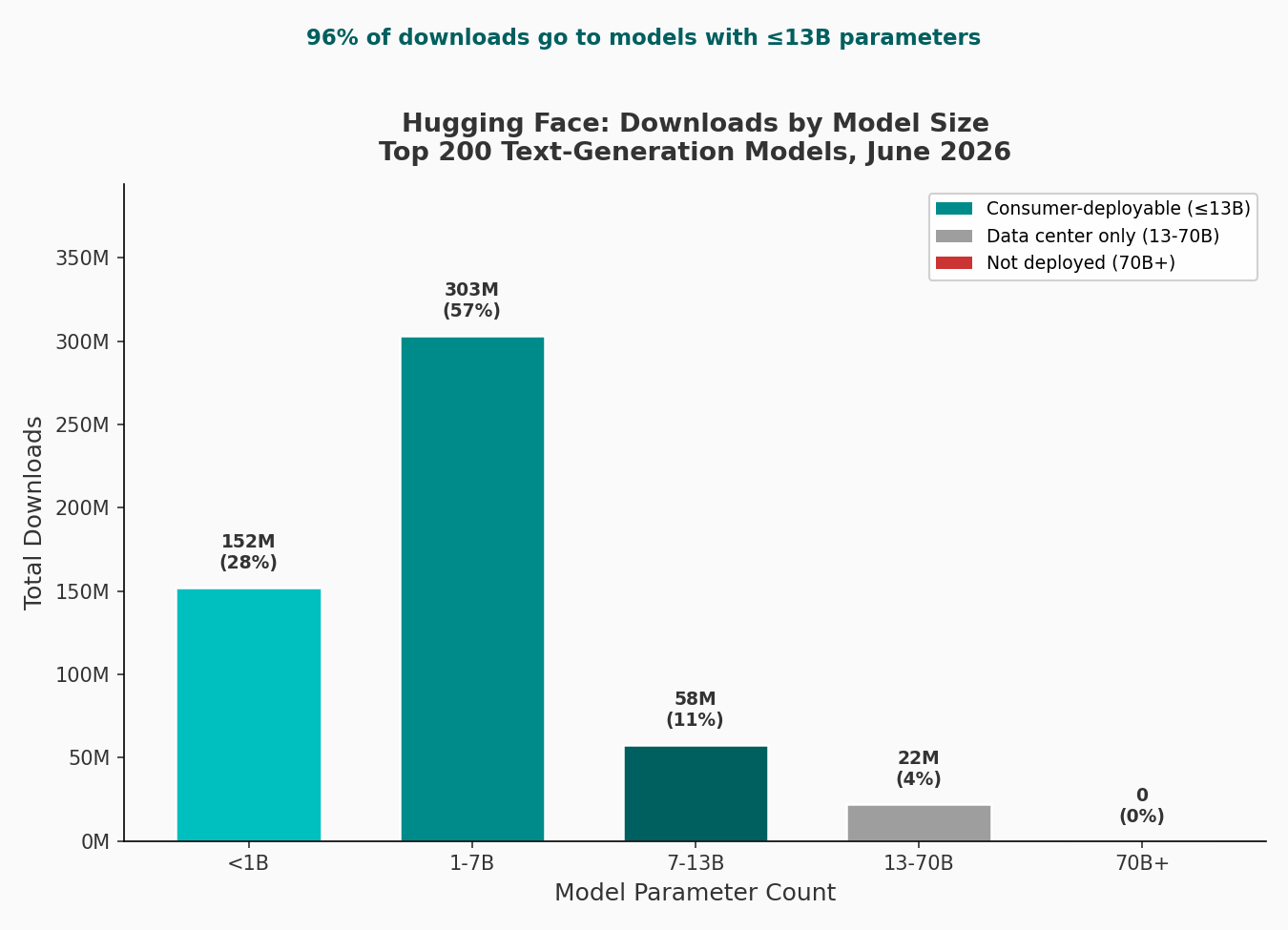
    We pulled download data from the Hugging Face API for the 200 most-downloaded text-generation models, queried June 2026. Models were classified by parameter count from their tags and model IDs; quantized variants (GGUF, GPTQ, AWQ) were counted at their base model size; models without identifiable parameter counts were excluded. Download counts are an imperfect proxy for production usage, but they remain one of the clearest public signals of where practitioner demand sits. The pattern is unambiguous.

    Of models with identifiable parameter counts, 96% of all downloads go to models with 13 billion parameters or fewer. Models that fit on one consumer GPU. The 1-7B bracket alone accounts for 303 million downloads, 44% of all traffic. Sub-1B models take another 22%.
    hf_downloads_by_size

    Models above 70 billion parameters do not appear in the top 200 at all. Quantized variants of Meta's Llama 3, Mistral AI's Mistral 7B, and Microsoft's Phi-3 dominate the charts. Practitioners download them because those models run on hardware they own.

    GGUF-format models, pre-quantized for consumer GPUs and CPUs, have become the default distribution format for open-source LLMs. On Hugging Face, the quantized variants of Llama, Mistral, and Phi consistently outperform their full-precision originals in download count. Practitioners want the model that fits their hardware.

    PyPI confirms it from the tooling side. bitsandbytes (quantization) pulls 6.4 million downloads per month. vllm (inference optimization) pulls 5.4 million. These tools exist because the compute problem is unsolved.
    vram_gap

    The Economics of Efficiency

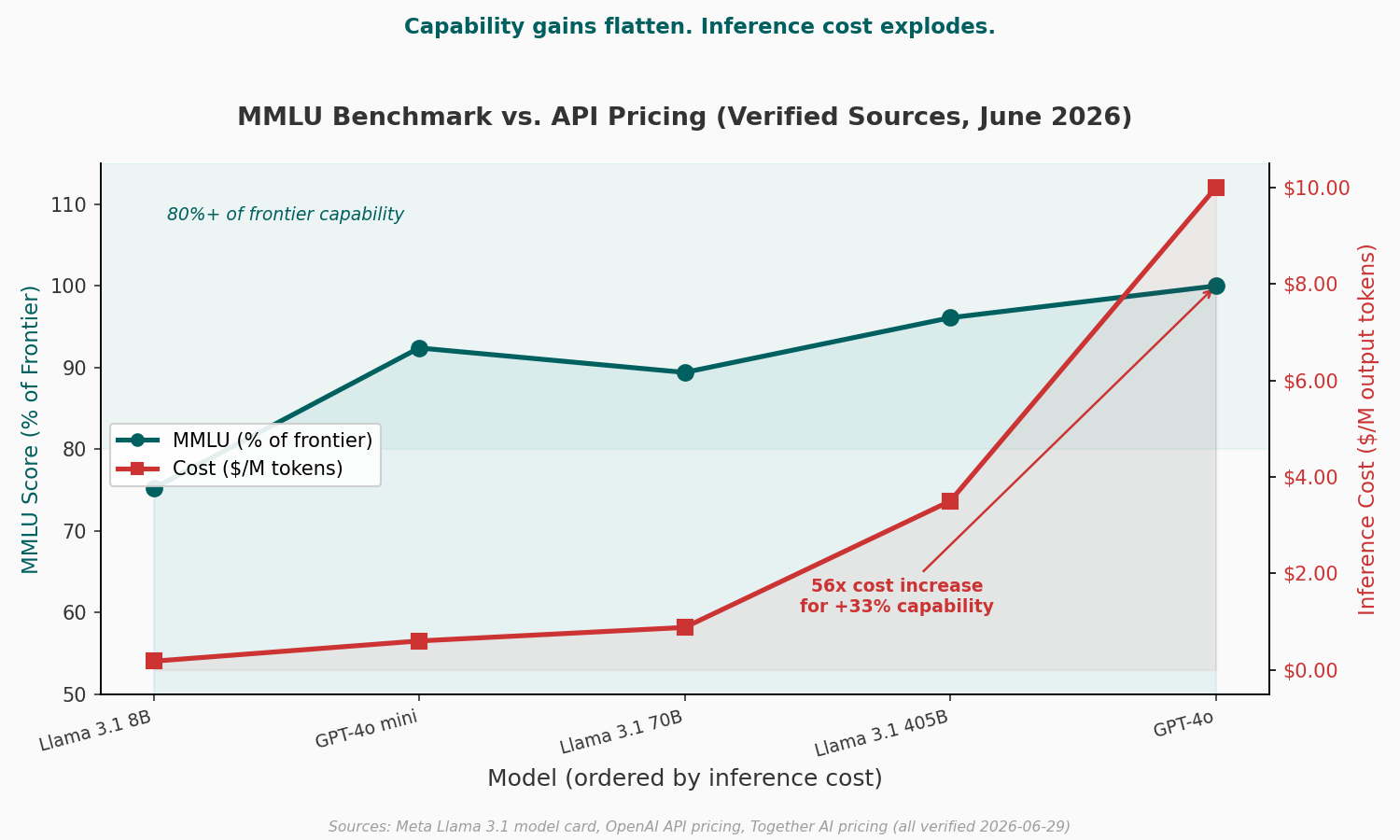
    cost_vs_capability

    Every 2x reduction in inference cost doubles the number of problems AI can economically solve. A workload that loses money at $15 per million tokens becomes profitable at $7. Use cases gated by $40,000 GPU clusters become viable on $1,600 consumer cards.

    Frontier models matter as the starting point. Distillation, synthetic data, and teacher-student training all begin with the largest models. The competitive moat is in making that capability cheap enough to deploy at scale.

    Compression proves the gap is closeable. Phi-3 Mini at 3.8B parameters scores 68.8% on MMLU, within 1.2 percentage points of GPT-3.5-turbo. Llama 3.1 8B achieves 75% of GPT-4o's MMLU score at 56x lower inference cost. Models one-hundredth the size of frontier systems are closing the capability gap in months.

    The optimization techniques already exist. Quantization compresses weights to fit smaller memory. Speculative decoding uses small draft models to speed up larger ones. Mixture-of-Experts activates a fraction of parameters per token, and knowledge distillation trains compact models to replicate larger ones on targeted tasks.

    Each technique trades raw parameter count for compute efficiency: more useful output per GPU dollar, more capability per gigabyte of VRAM. Intel made the same trade when it killed Netburst.

    Where the Value Shifts

    If model capability is commoditizing, durable advantage shifts to everything around the model. Inference optimization. Domain-specific fine-tuning. Orchestration and agent reliability. Latency. Observability. Data pipeline quality. These problems do not generate benchmark headlines, but they determine whether a business can deploy AI profitably.

    The next winners will come from the inference stack: vLLM, TensorRT, custom inference ASICs, compiler teams, serving infrastructure that makes a 7B model fast enough to replace a frontier API call. Intel's pivot created entire competitive categories that did not exist under Netburst. AI's compute pivot will seed a generation of companies built on inference, not parameters.

    The gains compound. Cheaper inference enables more deployment, which generates better task-specific training data, which produces more capable specialized models requiring less compute. Each turn of that flywheel widens the moat between organizations optimizing for deployment and organizations chasing benchmark records.

    Whoever controls that flywheel captures commercial AI's next decade. Frontier capability will keep advancing. Revenue will flow to whoever makes that capability cheap, fast, and deployable on real-world hardware.

    The Pivot Is Coming

    Once the CPU pivot happened, it was permanent. Nobody went back to chasing clock speed. Multi-core designs and instructions-per-watt replaced MHz as the competitive axis for two decades.

    ARM processors, built for efficiency from the ground up, went from phones to Apple's M-series laptops to cloud data centers. Efficiency did not win one product cycle. It restructured the entire compute market.

    Intel's pivot from Prescott to Core 2 took 18 months once the wall became undeniable. The compute efficiency wall in AI is already here. 96% of model downloads already reflect it: practitioners choose models sized for their hardware and build with tools that optimize inference.

    The lab that makes GPT-4-class capability run on a $500 device will have done more for AI adoption than the lab that trains GPT-5. The AI industry's Core 2 Duo moment is overdue. Whoever builds it owns the next decade.

    Sources

    • - [Hugging Face Model API](https://huggingface.co/api/models) - Text-generation model download data, queried June 29, 2026


    • PyPI Stats API

    • Meta Llama 3.1 Model Card

    • Microsoft Phi-3 Technical Report

    • OpenAI GPT-4o Pricing

    • Together AI Pricing

    • Intel ARK

    • - NVIDIA GeForce Specifications

    Share
    Tags: LLM Open Source AI AI Infrastructure AI Economics
    Jacob Krell
    Jacob Krell

    Jacob Krell builds systems that are hard to break and breaks systems that appear resilient. He is an offensive security leader specializing in advanced penetration testing and red teaming across cloud, web, mobile, Active Directory, and AI-enabled environments, helping organizations expose real-world risk and validate their defenses against modern adversaries. In parallel, he is a full-stack software engineer who develops custom cybersecurity tooling, intelligent automation platforms, and production-grade applications that embed security directly into the technology lifecycle. Ranked 25th globally on Hack The Box with more than 1,000 flags captured and holding many elite certifications, including OSCE3, CISSP, OSCP, CCNP Security, and CSIE, Jacob combines hands-on technical depth with the ability to translate complex cyber risk into clear business strategy.

    Stay ahead of the threat landscape

    AI security insights, threat intelligence, and research from our team. No spam, unsubscribe anytime.

    Subscribe
    ← Previous The Kylie Effect: How Meta Just Normed the Smart Glasses Privacy Dilemma

    Latest Posts

    View All
    The AI Industry's Prescott Moment
    LLM
    Jun 30, 2026 Jacob Krell

    The AI Industry's Prescott Moment

    Intel killed its fastest chip in 2004 because clock speed had become the wrong metric. AI is approaching the same ...

    Read More: The AI Industry's Prescott Moment
    The Kylie Effect: How Meta Just Normed the Smart Glasses Privacy Dilemma
    Data Privacy
    Jun 30, 2026 Hannah Perez

    The Kylie Effect: How Meta Just Normed the Smart Glasses Privacy Dilemma

    When tech companies first tried to put cameras on our faces, the public reaction was loud, clear, and overwhelmingly ...

    Read More: The Kylie Effect: How Meta Just Normed the Smart Glasses Privacy Dilemma
    The Extortion Market Has Matured, And the Response Industry Is Part of It
    Threat Intelligence
    Jun 25, 2026 Denis Calderone

    The Extortion Market Has Matured, And the Response Industry Is Part of It

    In May, a criminal extortion group told 9,000 schools to hire breach coaches and negotiate ransom payments ...

    Read More: The Extortion Market Has Matured, And the Response Industry Is Part of It
    The ICS Exploit Pipeline Is Built for Destruction, Not Theft
    Vulnerability Management
    Jun 22, 2026 Jacob Krell

    The ICS Exploit Pipeline Is Built for Destruction, Not Theft

    The vulnerability pipeline feeding ICS attackers is structurally optimized for breaking infrastructure, not stealing ...

    Read More: The ICS Exploit Pipeline Is Built for Destruction, Not Theft
    973 MCP Packages, 71% Single-Maintainer: A Practitioner's Guide to AI Developer Security
    Prompt Injection
    Jun 17, 2026 Jacob Krell

    973 MCP Packages, 71% Single-Maintainer: A Practitioner's Guide to AI Developer Security

    At a Glance AI security tooling adoption lags behind AI coding tool adoption by an order of magnitude. Download ratios: ...

    Read More: 973 MCP Packages, 71% Single-Maintainer: A Practitioner's Guide to AI Developer Security
    The AI Governance Gap: Verizon's 2026 DBIR Shows Attackers Scaling AI While Employees Leak Data Through It
    AI Governance
    May 28, 2026 Jacob Krell

    The AI Governance Gap: Verizon's 2026 DBIR Shows Attackers Scaling AI While Employees Leak Data Through It

    On May 20, 2026, Verizon published the 2026 Data Breach Investigations Report with a dedicated AI section built on ...

    Read More: The AI Governance Gap: Verizon's 2026 DBIR Shows Attackers Scaling AI While Employees Leak Data Through It
    The Remediation Paradox: Verizon's 2026 DBIR Shows Exploitation Winning While Defenders Patch Slower
    Mean Time to Exploit
    May 21, 2026 Jacob Krell

    The Remediation Paradox: Verizon's 2026 DBIR Shows Exploitation Winning While Defenders Patch Slower

    On May 20, 2026, Verizon published the [2026 Data Breach Investigations ...

    Read More: The Remediation Paradox: Verizon's 2026 DBIR Shows Exploitation Winning While Defenders Patch Slower
    The Extension Blind Spot: How One VS Code Plugin Gave Attackers GitHub's Source Code
    Cybersecurity
    May 20, 2026 Jacob Krell

    The Extension Blind Spot: How One VS Code Plugin Gave Attackers GitHub's Source Code

    GitHub's 3,800 Repositories Stolen Through a Single IDE Extension On May 19, 2026, a single VS Code extension on a ...

    Read More: The Extension Blind Spot: How One VS Code Plugin Gave Attackers GitHub's Source Code
    The Cost of a Click: Why Passive Cookie Consent Is Your Biggest Compliance Liability
    May 20, 2026 Hannah Perez

    The Cost of a Click: Why Passive Cookie Consent Is Your Biggest Compliance Liability

    If you think a basic pop-up banner that reads "By continuing to browse this site, you accept cookies" protects your ...

    Read More: The Cost of a Click: Why Passive Cookie Consent Is Your Biggest Compliance Liability
    Five Years of US Privacy Breach Data Tell a Story Security Leaders Cannot Ignore
    Data Privacy
    May 19, 2026 Jacob Krell

    Five Years of US Privacy Breach Data Tell a Story Security Leaders Cannot Ignore

    In April 2026 alone, the ShinyHunters extortion group breached ADT (5.5 million customers), Amtrak (2.1 million ...

    Read More: Five Years of US Privacy Breach Data Tell a Story Security Leaders Cannot Ignore
    Mean Time to Exploit Has Gone Negative. Security Strategy Has to Change.
    Vulnerability Management
    May 05, 2026 Jacob Krell

    Mean Time to Exploit Has Gone Negative. Security Strategy Has to Change.

    Mandiant's M-Trends 2026 report puts estimated mean time to exploit at negative seven days. That number should reset ...

    Read More: Mean Time to Exploit Has Gone Negative. Security Strategy Has to Change.
    When AI Billing Breaks Trust: What the Claude Code Backlash Says About AI Governance
    Prompt Injection
    Apr 30, 2026 Hannah Perez

    When AI Billing Breaks Trust: What the Claude Code Backlash Says About AI Governance

    When AI Billing Breaks Trust: Lessons from the Claude Code Backlash AI adoption is accelerating, but trust is still ...

    Read More: When AI Billing Breaks Trust: What the Claude Code Backlash Says About AI Governance
    From Army Ranger to Ethical Hacker: What Cybersecurity Can Learn from the Battlefield
    Cybersecurity
    Apr 29, 2026 Suzu Labs

    From Army Ranger to Ethical Hacker: What Cybersecurity Can Learn from the Battlefield

    Cybersecurity doesn’t start with tools, it starts with mindset. In this episode featuring Aaron Colclough, we get a ...

    Read More: From Army Ranger to Ethical Hacker: What Cybersecurity Can Learn from the Battlefield
    When Elite Cyber Teams Can't Crack Web Security
    Cybersecurity
    Apr 23, 2026 Jacob Krell

    When Elite Cyber Teams Can't Crack Web Security

    HTB's 2025 benchmark tested 796 security teams. Only 21% passed web security challenges. The Security Illusion Security ...

    Read More: When Elite Cyber Teams Can't Crack Web Security
    The Invisible Threat: Business Logic Flaws in Modern Applications and Why Scanners Miss Them
    Cybersecurity
    Apr 22, 2026 Jacob Krell

    The Invisible Threat: Business Logic Flaws in Modern Applications and Why Scanners Miss Them

    In today's security landscape, some of the most dangerous vulnerabilities aren't flagged by automated scanners at all. ...

    Read More: The Invisible Threat: Business Logic Flaws in Modern Applications and Why Scanners Miss Them
    Suzu Labs Acquires Emulated Criminals
    Apr 20, 2026 Hannah Perez

    Suzu Labs Acquires Emulated Criminals

    Bridging the gap between theory and the threat reality, Suzu Labs is proud to announce the acquisition of Emulated ...

    Read More: Suzu Labs Acquires Emulated Criminals
    The Wall Around Claude 4.7 Does Not Extend to Dread
    Cybersecurity
    Apr 17, 2026 Suzu Labs

    The Wall Around Claude 4.7 Does Not Extend to Dread

    Anthropic released Claude Opus 4.7 on April 16, 2026 with automated cybersecurity safeguards and a Cyber Verification ...

    Read More: The Wall Around Claude 4.7 Does Not Extend to Dread
    The Engagement Ratchet: How YouTube, Instagram, and Amazon Trained Users to Accept Less Control
    youtube
    Apr 10, 2026 Jacob Krell

    The Engagement Ratchet: How YouTube, Instagram, and Amazon Trained Users to Accept Less Control

    Earlier this year, YouTube began rolling out a row of algorithmically recommended videos at the top of the ...

    Read More: The Engagement Ratchet: How YouTube, Instagram, and Amazon Trained Users to Accept Less Control
    The AI Revolution: How Jobs Will Change by 2030
    Cybersecurity
    Apr 07, 2026 Suzu Labs

    The AI Revolution: How Jobs Will Change by 2030

    Host Phillip Wylie sits down with Nicolas Chaillan to discuss the sobering reality of AI replacement, the critical need ...

    Read More: The AI Revolution: How Jobs Will Change by 2030
    The Rosie Protocol: Is AI-Driven Personalized Medicine Finally Here?
    Generative AI
    Apr 01, 2026 Hannah Perez

    The Rosie Protocol: Is AI-Driven Personalized Medicine Finally Here?

    In late 2024, Sydney tech entrepreneur Paul Conyngham was told his rescue dog, Rosie, had months to live. She was ...

    Read More: The Rosie Protocol: Is AI-Driven Personalized Medicine Finally Here?
    From Analog Hacks to Agentic AI: The Evolution of Offensive Security with Denis Calderone
    Cybersecurity
    Mar 30, 2026 Suzu Labs

    From Analog Hacks to Agentic AI: The Evolution of Offensive Security with Denis Calderone

    The world of cybersecurity has undergone a massive transformation in just a few decades. In this episode of Simply ...

    Read More: From Analog Hacks to Agentic AI: The Evolution of Offensive Security with Denis Calderone
    While TSA Made Headlines, CISA Went Dark
    Critical Infrastructure
    Mar 30, 2026 Jacob Krell

    While TSA Made Headlines, CISA Went Dark

    The Department of Homeland Security has been partially shut down for over 45 days. In that time, 460 TSA officers have ...

    Read More: While TSA Made Headlines, CISA Went Dark
    The Purple Team Advantage: Bridging the Gap Between Hacking and Management with Chris Marks
    AI Security
    Mar 30, 2026 Suzu Labs

    The Purple Team Advantage: Bridging the Gap Between Hacking and Management with Chris Marks

    In cybersecurity, we often operate in silos. The red team breaks things, the blue team fixes them, and management ...

    Read More: The Purple Team Advantage: Bridging the Gap Between Hacking and Management with Chris Marks
    Claude Mythos and the Cybersecurity Risk That Was Already Here
    Threat Intelligence
    Mar 27, 2026 Jacob Krell

    Claude Mythos and the Cybersecurity Risk That Was Already Here

    On March 26, Anthropic confirmed the existence of Claude Mythos, an unreleased AI model described internally as "a step ...

    Read More: Claude Mythos and the Cybersecurity Risk That Was Already Here
    BPFdoor in Telecom Networks: The FCC Is Securing the Edge, but China's Hackers Are Already Past It
    Critical Infrastructure
    Mar 26, 2026 Mike Bell

    BPFdoor in Telecom Networks: The FCC Is Securing the Edge, but China's Hackers Are Already Past It

    Rapid7's research reveals China-linked kernel implants deep inside telecom signaling infrastructure. Here's what ...

    Read More: BPFdoor in Telecom Networks: The FCC Is Securing the Edge, but China's Hackers Are Already Past It
    Securing the AI Frontier: Suzu Labs Sweeps 4 Global InfoSec Awards 2026
    Cybersecurity
    Mar 23, 2026 Hannah Perez

    Securing the AI Frontier: Suzu Labs Sweeps 4 Global InfoSec Awards 2026

    We are incredibly proud to announce a monumental achievement. At this year’s Global InfoSec Awards 2026, hosted by ...

    Read More: Securing the AI Frontier: Suzu Labs Sweeps 4 Global InfoSec Awards 2026
    From Cockpits to Code: Josh Mason on Bridging the Gap Between Military and Cybersecurity
    Cybersecurity
    Mar 17, 2026 Suzu Labs

    From Cockpits to Code: Josh Mason on Bridging the Gap Between Military and Cybersecurity

    In the world of cybersecurity, we often talk about "gatekeeping" or the "skills gap," but rarely do we find individuals ...

    Read More: From Cockpits to Code: Josh Mason on Bridging the Gap Between Military and Cybersecurity
    Simply Offensive Podcast: The Future of Pentesting: AI, Automation, and Better Reporting with Dan DeCloss
    Cybersecurity
    Mar 16, 2026 Phillip Wylie

    Simply Offensive Podcast: The Future of Pentesting: AI, Automation, and Better Reporting with Dan DeCloss

    The Future of Pentesting: AI, Automation, and Better Reporting with Dan DeCloss In this episode of Simply Offensive, ...

    Read More: Simply Offensive Podcast: The Future of Pentesting: AI, Automation, and Better Reporting with Dan DeCloss
    From Silence to Strike: Tracking Iran's Cyber Escalation in Real Time
    Critical Infrastructure
    Mar 13, 2026 Denis Calderone

    From Silence to Strike: Tracking Iran's Cyber Escalation in Real Time

    On March 12, medical technology giant Stryker confirmed a cyberattack that wiped devices across 79 countries. The ...

    Read More: From Silence to Strike: Tracking Iran's Cyber Escalation in Real Time
    Internal Analysis: Even Realities G2 Smart Glasses Security & Privacy Investigation
    Social Engineering
    Mar 09, 2026 Suzu Labs Intelligence

    Internal Analysis: Even Realities G2 Smart Glasses Security & Privacy Investigation

    Executive Summary Even Realities markets its G2 smart glasses as the privacy-conscious alternative to Meta Ray-Bans. ...

    Read More: Internal Analysis: Even Realities G2 Smart Glasses Security & Privacy Investigation
    The Company Reviewing Your Meta Glasses Footage Has a Security Problem
    Threat Intelligence
    Mar 06, 2026 Mike Bell

    The Company Reviewing Your Meta Glasses Footage Has a Security Problem

    Last week, Swedish journalists revealed that Meta sends video footage from Meta Ray-Ban smart glasses to human data ...

    Read More: The Company Reviewing Your Meta Glasses Footage Has a Security Problem
    The Death of the CTF: How Agentic AI Is Reshaping Competitive Hacking
    CTF
    Mar 03, 2026 Jacob Krell

    The Death of the CTF: How Agentic AI Is Reshaping Competitive Hacking

    View White Paper Abstract: Agentic AI systems are compressing competitive hacking timelines faster than the ...

    Read More: The Death of the CTF: How Agentic AI Is Reshaping Competitive Hacking
    Simply Offensive Podcast: AI Killed the CTF Star with Jacob Krell
    Cybersecurity
    Mar 03, 2026 Phillip Wylie

    Simply Offensive Podcast: AI Killed the CTF Star with Jacob Krell

    In this thought-provoking episode of Simply Offensive, host Philip Wylie sits down with Jacob Krell, a penetration ...

    Read More: Simply Offensive Podcast: AI Killed the CTF Star with Jacob Krell
    Anthropic and Claude: 2026 AI Powerhouse
    Supply Chain Security
    Feb 26, 2026 Hannah Perez

    Anthropic and Claude: 2026 AI Powerhouse

    In early 2026, the image of Anthropic as a cautious, safety-oriented "research lab" has effectively been replaced by ...

    Read More: Anthropic and Claude: 2026 AI Powerhouse
    Simply Offensive Podcast: Navigating AI's Challenges in Problem Solving with Darius Houle
    Cybersecurity
    Feb 24, 2026 Phillip Wylie

    Simply Offensive Podcast: Navigating AI's Challenges in Problem Solving with Darius Houle

    In this episode of Simply Offensive, host Philip Wylie welcomes Darius Houle, an Application Security (AppSec) and ...

    Read More: Simply Offensive Podcast: Navigating AI's Challenges in Problem Solving with Darius Houle
    Simply Offensive Podcast: Exploring the World of Hardware Hacking with Matt Brown
    Cybersecurity
    Feb 17, 2026 Phillip Wylie

    Simply Offensive Podcast: Exploring the World of Hardware Hacking with Matt Brown

    In the latest episode of the Simply Offensive podcast, host Philip Wylie sat down with Matt Brown, a renowned hardware ...

    Read More: Simply Offensive Podcast: Exploring the World of Hardware Hacking with Matt Brown
    Simply Offensive Podcast: Exploring AI Vulnerabilities in Cybersecurity with Mike Bell of Suzu Labs
    Cybersecurity
    Feb 12, 2026 Phillip Wylie

    Simply Offensive Podcast: Exploring AI Vulnerabilities in Cybersecurity with Mike Bell of Suzu Labs

    In today’s rapidly evolving technological landscape, the convergence of artificial intelligence (AI) and cybersecurity ...

    Read More: Simply Offensive Podcast: Exploring AI Vulnerabilities in Cybersecurity with Mike Bell of Suzu Labs
    Simply Offensive Podcast: Emulated Cyber Crime with Dahvid Schloss
    Threat Intelligence
    Feb 10, 2026 Phillip Wylie

    Simply Offensive Podcast: Emulated Cyber Crime with Dahvid Schloss

    Beyond the Pentest: Why Adversarial Emulation is the Future of Defensive Training Many organizations operate under the ...

    Read More: Simply Offensive Podcast: Emulated Cyber Crime with Dahvid Schloss
    Under Armour Breach: What The Forum Data Actually Shows
    Threat Intelligence
    Jan 30, 2026 Mike Bell

    Under Armour Breach: What The Forum Data Actually Shows

    On January 18, 2026, the Everest ransomware group made good on their threat and released Under Armour customer data to ...

    Read More: Under Armour Breach: What The Forum Data Actually Shows
    SilentFrame: A Research POC on Post-Exploitation Credential Collection through Browsers
    Briefing Room
    Jan 29, 2026 Dahvid Schloss

    SilentFrame: A Research POC on Post-Exploitation Credential Collection through Browsers

    This article is in reference to our newest POC hosted on GitHub here: https://github.com/Emulated-Criminals/SilentFrame ...

    Read More: SilentFrame: A Research POC on Post-Exploitation Credential Collection through Browsers
    Brightspeed Breach: Crimson Collective and the Infostealer Problem
    Threat Intelligence
    Jan 20, 2026 Mike Bell

    Brightspeed Breach: Crimson Collective and the Infostealer Problem

    Recently Crimson Collective claimed they breached Brightspeed and grabbed 1 million+ customer records. The list of data ...

    Read More: Brightspeed Breach: Crimson Collective and the Infostealer Problem
    When Grid Data Goes Dark Web
    Power Grid
    Jan 19, 2026 Mike Bell

    When Grid Data Goes Dark Web

    Inside a threat actor's critical infrastructure targeting In January 2026, 139 gigabytes of engineering data from a ...

    Read More: When Grid Data Goes Dark Web
    The $150,000 Password
    Critical Infrastructure
    Jan 19, 2026 Mike Bell

    The $150,000 Password

    How one threat actor turned stolen credentials into a global breach portfolio Between December 2025 and January 2026, a ...

    Read More: The $150,000 Password
    Seeing Everything, Understanding Nothing
    Briefing Room
    Jan 16, 2026 Dahvid Schloss

    Seeing Everything, Understanding Nothing

    To help you get a head start on making your environment safer and in keeping with the theme of January’s “New Year, New ...

    Read More: Seeing Everything, Understanding Nothing
    New Year, New Priorities - So, what to fix first?
    Briefing Room
    Jan 08, 2026 Dahvid Schloss

    New Year, New Priorities - So, what to fix first?

    The most common phrase we hear from our prospects is, “We are overwhelmed, and we aren’t sure what to tackle first.” ...

    Read More: New Year, New Priorities - So, what to fix first?
    UnderByte — A Ransomware experiment using Alternate Data Streams (ADS)
    Briefing Room
    Nov 21, 2025 Dahvid Schloss

    UnderByte — A Ransomware experiment using Alternate Data Streams (ADS)

    Repository purpose: this research was to evaluate the feasiabilty of using Alternate Data Stream (ADS) in staging and ...

    Read More: UnderByte — A Ransomware experiment using Alternate Data Streams (ADS)
    Logo copy 3-1

    Fortified Security. Intelligent Innovation.

    +1 (702) 766-6257
    P.O. Box 750111
    Las Vegas, Nevada 89136

    Follow Us

    About

    • About Us
    • Contact
    • FAQ's

    Solutions

    • AI Advisory
    • AI Assessment
    • Offensive Security
    • Defensive Security
    • Privacy Engineering
    • Adversarial Operations
    • Social Engineering
    • Products

    Resources

    • Blog
    • In The Media
    • Podcasts
    © 2026 All rights reserved.
    • Privacy Policy
    • Terms & Conditions