SUZU Offensive Security Solutions

Network Penetration Testing

Your network is the most common entry point for real-world attackers. Suzu Labs Network Penetration Testing covers both internal and external infrastructure, mapping lateral movement, validating segmentation, and proving what an adversary can actually reach from a foothold or from outside your perimeter.

Network Penetration Testing Services

Prove What an Attacker Can Reach - Inside and Out

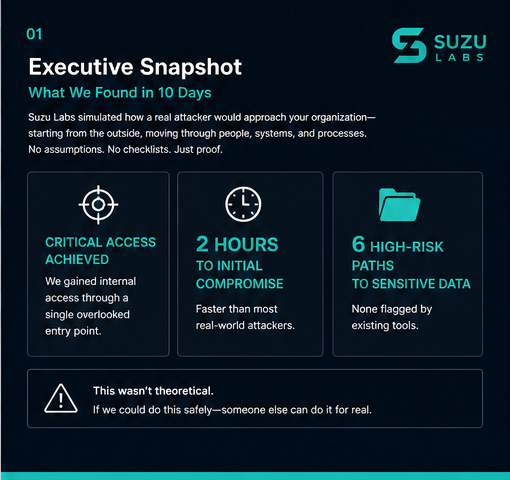
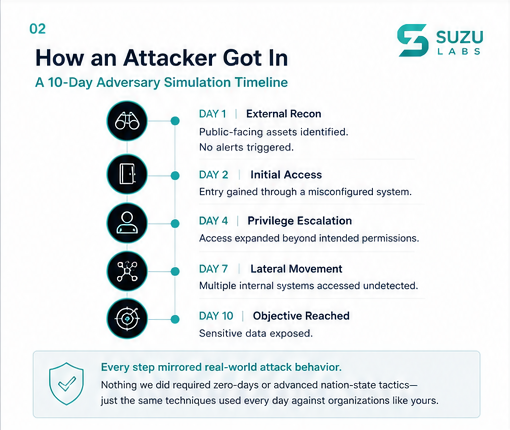
Most organizations assume their firewalls, VLANs, and endpoint protection will hold. Our network penetration testing starts from the assumption that they won't, and proves exactly where an attacker breaks through, how they move laterally, and what data or systems they can compromise.

We test both sides of your perimeter. External testing validates what an attacker sees from the internet. Internal testing simulates a compromised employee, a rogue contractor, or a foothold gained through phishing, and maps the blast radius from there.
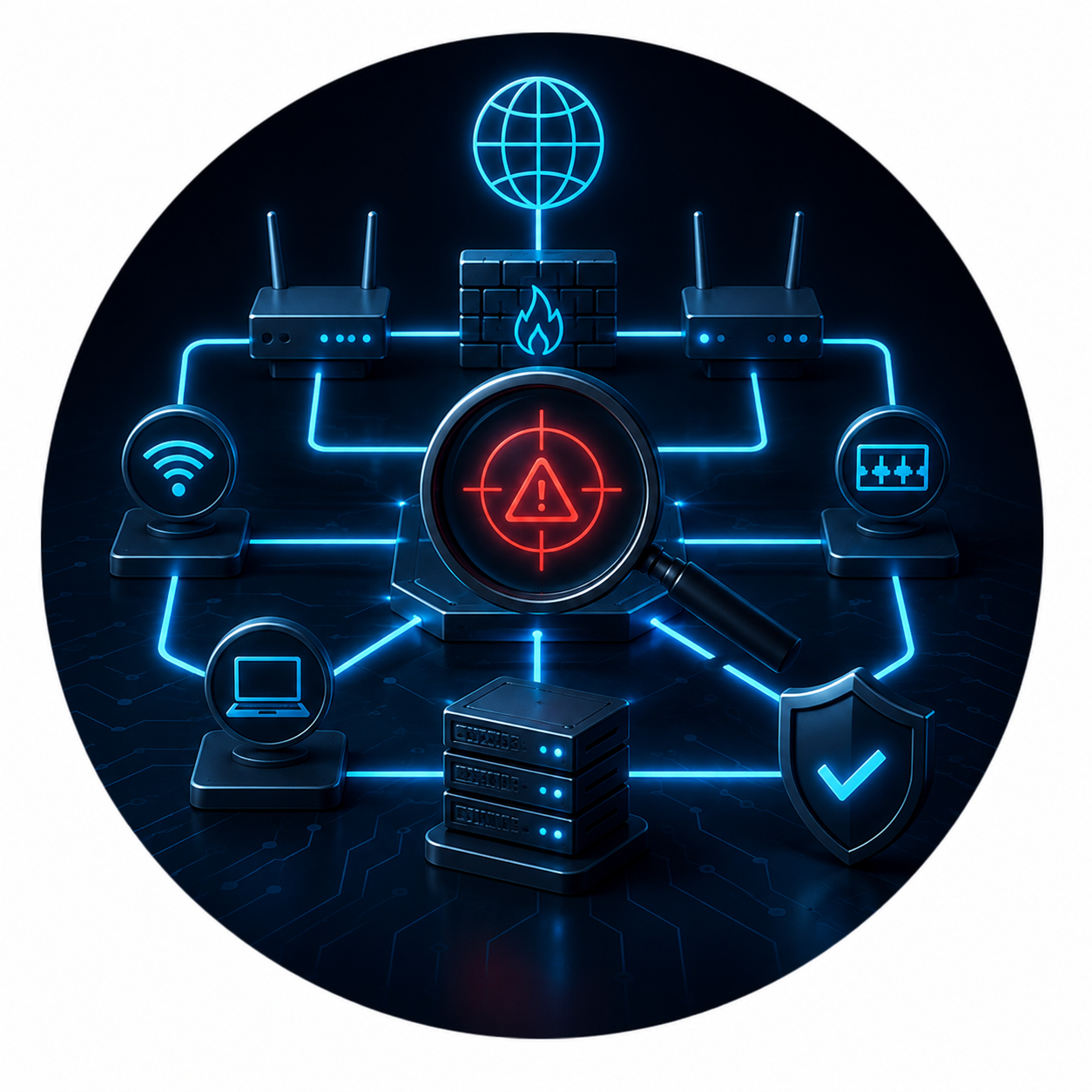
network pentesting

How We Test Networks

Covering Every Path an Attacker Would Take

Network pentesting isn't port scanning. We chain misconfigurations, credential weaknesses, and trust relationships into realistic attack paths, then document exactly how to close them.

External Perimeter Testing


We enumerate your external attack surface, identify exposed services, and attempt exploitation the way a remote attacker would, before they do. Covers DNS, web services, VPN endpoints, mail gateways, and cloud-adjacent infrastructure.

Learn more about external testing

Internal Network Testing

Starting from a simulated foothold inside the network, we test Active Directory security, credential harvesting (LLMNR/NBT-NS poisoning, NTLM relay), VLAN segmentation, and lateral movement paths to critical assets.


Learn more about internal testing

Active Directory Security

AD is the backbone of enterprise identity and the most targeted asset in internal engagements. We test Kerberoasting, AS-REP roasting, delegation abuse, GPO misconfigurations, and domain escalation paths to Domain Admin.


Learn more about AD security threats

Segmentation Validation

We verify that network segmentation controls actually work, testing VLAN hopping, firewall rule bypass, and inter-zone access to prove whether a compromise in one segment can reach your most critical assets.

Learn more about segmentation

Wireless Network Testing

We assess Wi-Fi security including WPA2/WPA3 authentication, rogue access point detection, guest network isolation, and whether wireless access provides a pivot path into production network segments.

Learn more about wireless testing

VPN & Remote Access

Remote access infrastructure is a high-value target. We test VPN configurations, split tunneling risks, MFA bypass scenarios, and whether remote connectivity provides unintended access to sensitive network zones.

Learn more about VPNs
PHYSICAL LAYER DEFENSE

Hardware Hacking

This usually comes up when something is on the line. A new device launch, customer trust, or protecting intellectual property.

We evaluate the security of your hardware and embedded systems to ensure they can’t be easily exploited, cloned, or manipulated in the real world.

  • When you’re shipping devices or relying on connected technology, unseen risks can lead to real consequences. From customer trust issues to expensive fixes. We help you catch those issues before they impact your business.
  • What We Hack: SCADA, IoT, OT, Vehicles, Embedded Systems.
ChatGPT Image May 4, 2026, 03_58_45 PM

Questions

Network Penetration Testing, Answered

External testing simulates an attacker operating from the internet with no prior access, targeting your public-facing infrastructure: DNS, web servers, VPN endpoints, mail gateways, and cloud services. Internal testing assumes an attacker has already gained a foothold inside the network (through phishing, a rogue employee, or a compromised device) and tests how far they can move laterally to reach critical systems, sensitive data, and privileged accounts like Domain Admin.

Very deeply, when Active Directory is part of the engagement scope. We go well beyond running a scanner against your domain controllers. Our operators ingest your AD environment into a graph database that maps every user, group, computer, GPO, trust relationship, session, and delegation path across the entire directory. This lets us visualize and query attack paths the way an adversary would: not just individual misconfigurations in isolation, but the chains of permissions that connect a low-privilege user account to Domain Admin. We test Kerberoasting, AS-REP roasting, unconstrained and constrained delegation abuse, GPO misconfigurations, password policy weaknesses, LLMNR/NBT-NS poisoning, NTLM relay attacks, and service account compromise. The graph-based approach means we catch escalation paths that checklist-style audits miss entirely, because the risk isn't in any single node but in how those nodes connect to each other.

Vulnerability scanners flag known CVEs and misconfigurations automatically, often with significant false positives. A penetration test is human-led: our operators manually verify findings, chain vulnerabilities together, and prove real-world impact, demonstrating actual lateral movement, data access, or privilege escalation rather than listing theoretical risks.


Yes. Segmentation validation is a core component. We test VLAN boundaries, firewall rules between zones, inter-site connectivity, and whether cardholder data environments (CDEs) or other compliance-scoped segments are truly isolated. This is especially relevant for PCI DSS, HIPAA, and CMMC compliance requirements.


Our testing is designed to avoid disruption. We coordinate with your team, agree on rules of engagement, avoid known-dangerous actions (like account lockouts or denial-of-service) unless explicitly approved, and schedule high-risk testing during maintenance windows. Safety is a non-negotiable part of our methodology.

Most network engagements run one to three weeks depending on the number of hosts, subnets, sites, and whether testing covers internal, external, or both. We provide a detailed timeline during the scoping call so expectations are clear before testing begins. If we discover a critical finding that poses an imminent threat to your environment, we escalate it to your team immediately. You will never be in a position where we are sitting on something dangerous waiting for a report deadline.

Yes. We leverage AI across our testing workflows to accelerate reconnaissance, analyze large data sets, and identify patterns that would take significantly longer manually. All AI tooling we use is internal and self-hosted or commercially licensed with enterprise data protections. Client data is never sent to public AI models or consumer-grade services. Your environment data stays under our control throughout the engagement.

The report is the beginning of the conversation, not the end. You get a live debrief with the operators who ran the engagement, walking through every finding, its real-world impact, and specific remediation steps. Findings are CVSS-scored and mapped to your compliance framework so your team can prioritize by risk. If your team needs hands-on help remediating, we can work alongside your engineers to close the gaps directly. Once fixes are in place, we conduct retesting to verify that each issue is truly resolved, not just patched on paper. We are not a firm that drops a PDF and disappears. We stay engaged until your environment is actually stronger.

Network Penetration Testing vs. Application Penetration Testing

Network Penetration Testing Application Penetration Testing
Scope Internal/external infrastructure, Active Directory, VPNs, firewalls, segmentation, wireless The web application itself, including its APIs, authentication flows, business logic, and integrations
Attack Surface Open ports, network services, credential protocols, trust relationships, routing User inputs, session handling, API endpoints, access controls, data flows between components
Common Vulnerabilities Weak credentials, unpatched services, AD misconfigurations, LLMNR/NTLM abuse, segmentation failures Injection flaws, broken access controls, authentication weaknesses, business logic abuse, insecure data handling
Testing Approach Simulates an attacker gaining a network foothold and moving laterally through infrastructure to reach critical systems Simulates an attacker targeting the application through its intended interfaces to access data, escalate privileges, or manipulate functionality
Impact if Compromised Domain compromise, ransomware deployment, mass data exfiltration, full network takeover Data breach, account takeover, unauthorized transactions, customer data exposure
Ideal For Organizations with on-prem infrastructure, Active Directory, multi-site networks, or VPN/remote access Organizations operating SaaS platforms, customer portals, e-commerce sites, or internal business applications

Verified expertise

Validate defenses. Reduce exposure.

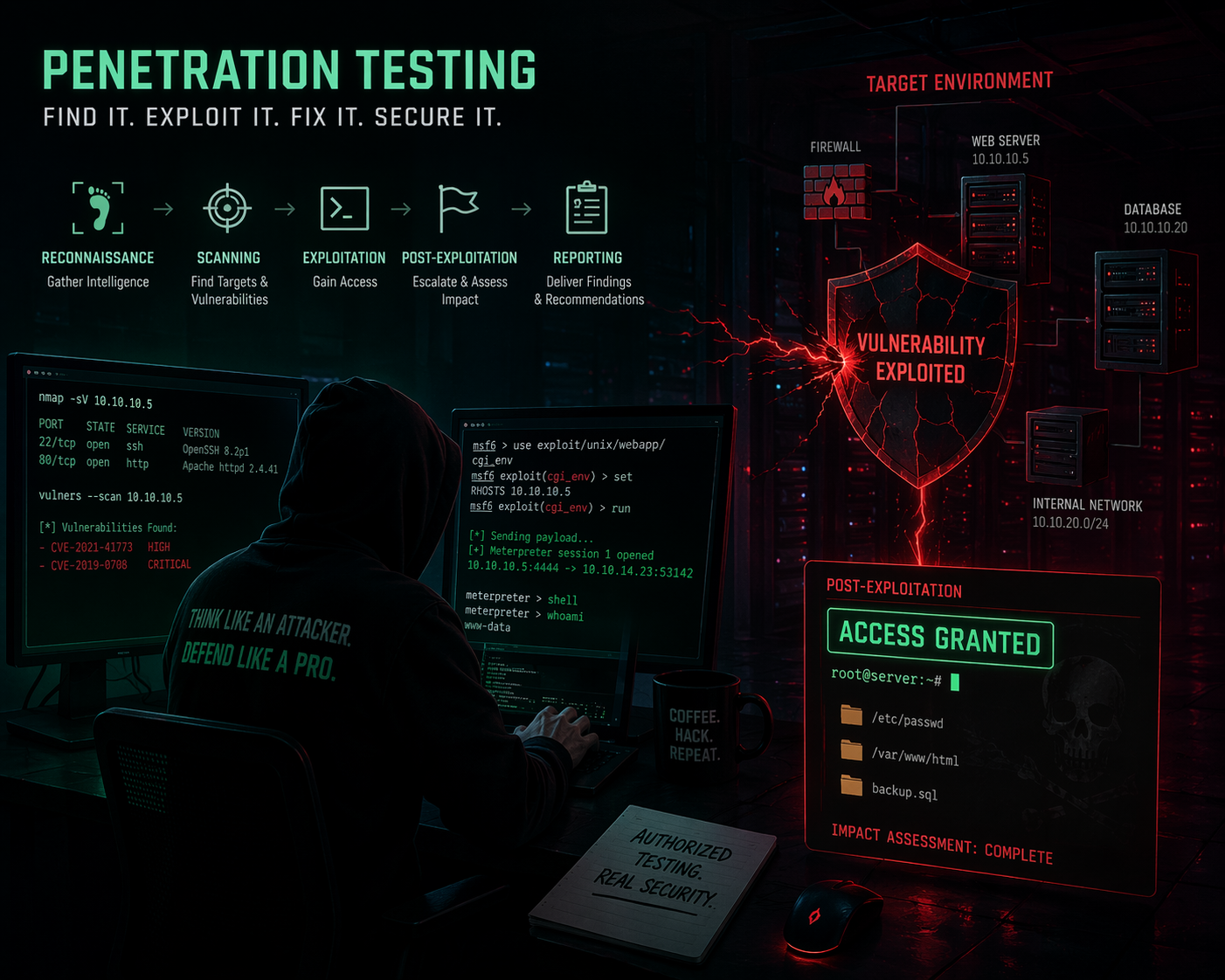
Penetration Testing

What It Is: We don't just scan for vulnerabilities; we exploit them safely to prove where your defenses might fail. Our offensive security experts simulate real-world attacks to identify complex misconfigurations and logic flaws across your entire infrastructure.


  • Full-Spectrum Testing: Deep dives into web apps, internal/external networks, and cloud environments.
  • Risk-Based Analysis: Understand exactly how an attacker could move laterally through your systems.
  • Continuous Validation: Transition from periodic "check-the-box" audits to a culture of constant defensive improvement.
  • What We Test: Web-App, Mobile App, API, External Network, Internal Network, WIFI, Cloud, IoT, Physical.

ChatGPT Image Apr 17, 2026, 01_54_29 PM
PHYSICAL LAYER DEFENSE

Hardware Hacking

What It Is: Modern attacks don’t stop at software. We analyze firmware, embedded systems, and IoT devices to uncover security gaps at the hardware level. From side-channel testing to reverse engineering, our hardware security services safeguard critical infrastructure and consumer technology alike.

  • Move beyond software patches by identifying vulnerabilities in firmware and embedded systems that traditional scanners miss, ensuring your hardware is secure from the first boot.
  • We simulate advanced attack vectors like side-channel analysis and reverse engineering to ensure your critical infrastructure and consumer tech can withstand hands-on exploitation.
  • Protect your brand and your users by uncovering hidden gaps in interconnected devices, preventing your hardware from becoming an easy entry point for larger network breaches.
  • What We Hack: SCADA, IoT, OT, Vehicles, Embedded Systems.
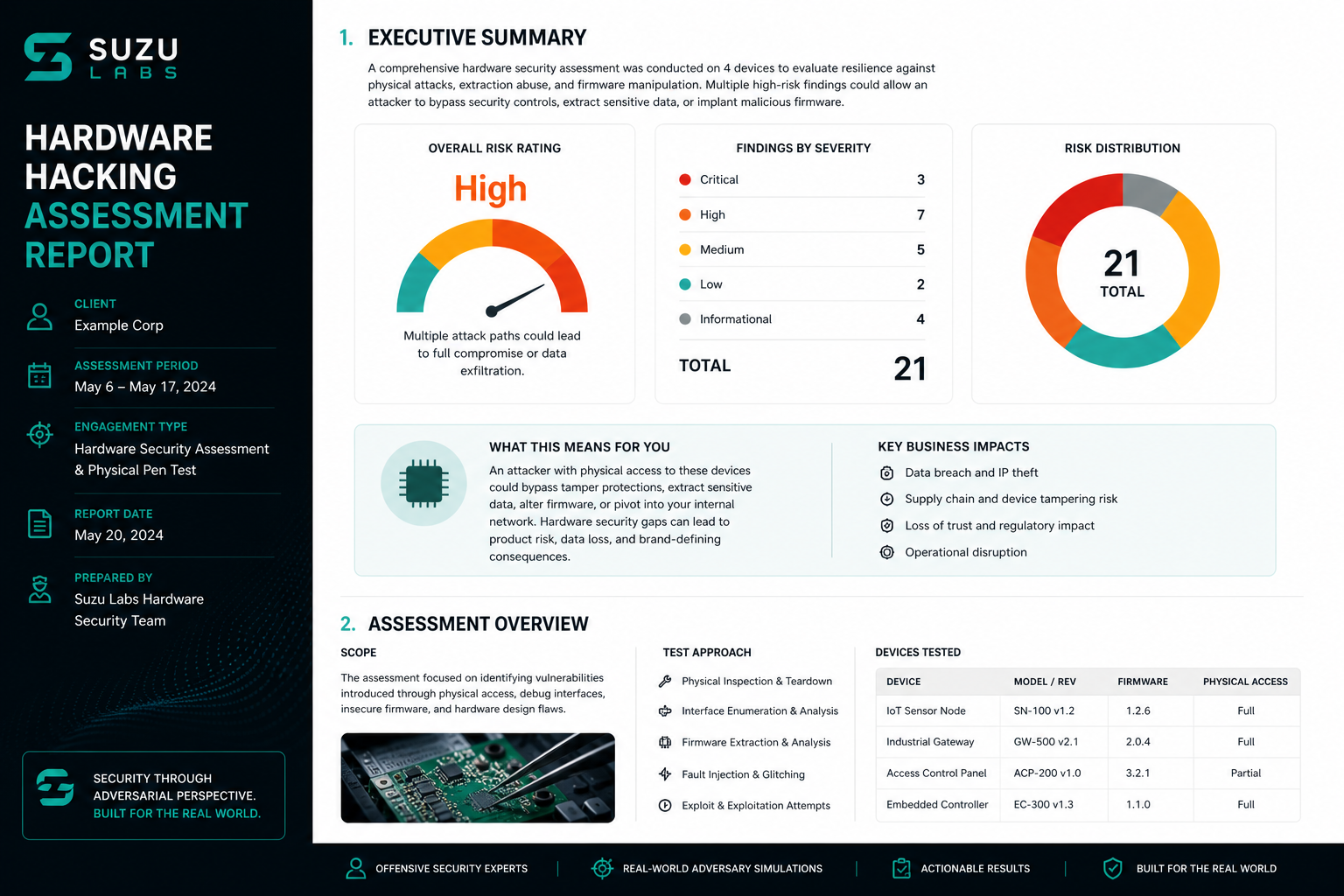
person hacking hardware
OFFENSE AND DEFENSE SYNERGY

Purple Team Exercises

What It Is: High-impact collaborative engagements where our offensive experts (Red) and defensive (Blue) teams work side by side to test detection and response capabilities, turning findings into immediate improvements.

  • Targeted Exploitation: We move beyond basic scanning to emulate specific TTPs (Tactics, Techniques, and Procedures) used by modern threat actors, ensuring your defenses are tested against actual adversary behavior.
  • Closing the Detection Gap: By mapping offensive actions to your specific security telemetry in real-time, we identify exactly where visibility fails and provide the code-level fixes to bridge those gaps.
  • Operational Resilience: We don't just find vulnerabilities; we use offensive data to build "detection-as-code," giving your team the playbooks needed to stop sophisticated lateral movement and data exfiltration.

Gemini_Generated_Image_du0jszdu0jszdu0j-1
PROVING DEFENSIVE EFFICACY

ThreatSIM — Attack Simulation & Service Validation

What It Is: ThreatSIM is our proprietary platform designed to simulate MITRE ATT&CK®–based adversary behaviors safely within client environments. Unlike point-in-time tests, ThreatSIM continuously validates the effectiveness of your security stack, your SOC, and your MSSP’s detection and response capabilities.

  • Move beyond static testing with ongoing simulations that verify your security stack, SOC, and MSSP are detecting and blocking threats in real time.
  • Safely emulate real-world adversary behaviors within your environment to ensure your defenses are tuned against the most current and relevant global attack tactics.
  • Eliminate guesswork by gathering concrete data on how well your existing tools and service providers perform, allowing you to bridge gaps before a real breach occurs.

Gemini_Generated_Image_uw8luluw8luluw8l-1
Book a threat briefing

If there’s a way in, we’ll find it first.

A patch is a start, but it isn't a strategy. Connect with our offensive security specialists to identify the logic flaws and lateral movement paths that put your critical assets at risk. Let’s build a roadmap to true resilience.

We'll be in touch within one business day to schedule your briefing. No sales follow-up sequence — just the briefing.

Reserve your briefing

Not Ready to Talk? Explore our Latest Research →

View All
The $2.83 Billion Security Lesson from GTA VI
Cybersecurity
Aug 21, 2026 Jacob Krell

The $2.83 Billion Security Lesson from GTA VI

Rockstar Games has suffered three major security exposures in four years. The latest wiped $2.83 ...
Read More: The $2.83 Billion Security Lesson from GTA VI
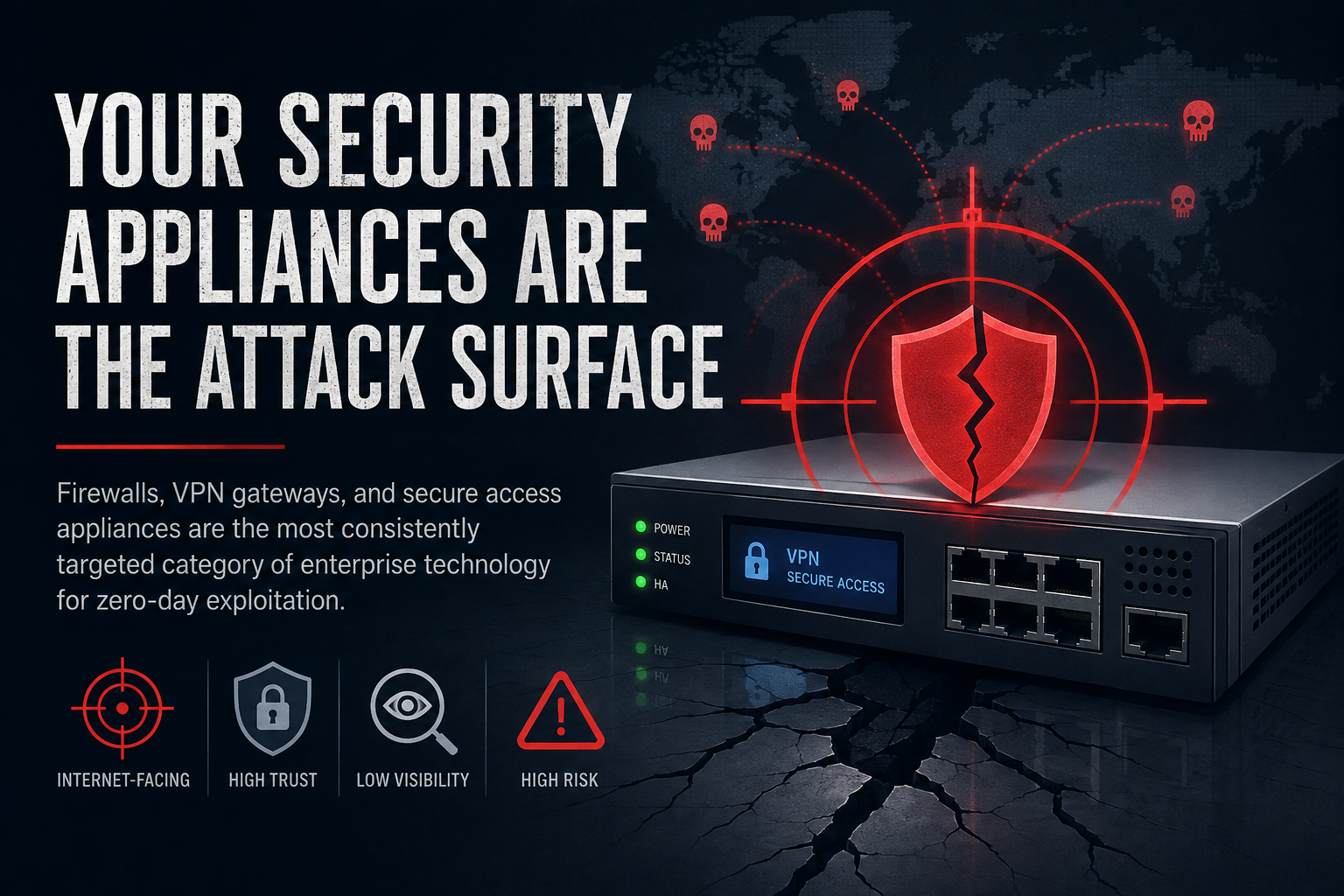
Your Security Appliances Are the Attack Surface
Zero-Day
Aug 18, 2026 Jacob Krell

Your Security Appliances Are the Attack Surface

Your Security Appliances Are the Attack Surface Security and networking appliances now represent ...

Read More: Your Security Appliances Are the Attack Surface