SUZU Offensive Security Solutions
OT Security Testing
Operational technology environments control physical processes that were never designed to withstand adversarial pressure. Suzu Labs OT Security Testing assesses SCADA systems, PLCs, industrial protocols, and the IT/OT boundary to prove what an attacker can reach, manipulate, or disrupt before it becomes a safety event.
Security Testing Where the Consequences Are Physical
IT security incidents result in data loss. OT security incidents can result in equipment damage, environmental releases, production shutdowns, and threats to human safety. That difference changes everything about how testing is scoped, executed, and reported.
We assess operational technology environments with the same adversarial rigor we apply to IT infrastructure, but with safety as a non-negotiable constraint. Every test is coordinated with your operations team, governed by strict rules of engagement, and designed to surface real risk without creating it. If your organization runs industrial control systems, building automation, or process control environments, this is the engagement that tests what matters most.

what we test
Assessing the Systems That Control Physical Processes
OT environments rely on protocols, architectures, and trust models that predate modern cybersecurity. We test the systems, boundaries, and access paths that determine whether an attacker can reach your operational environment and what they can do when they get there.
SCADA & HMI Assessment
We assess supervisory control and data acquisition systems and human-machine interfaces for unauthorized access, command injection, configuration manipulation, and historian database exposure. If an attacker can read or write to your SCADA environment, we find out how.
PLC & Controller Security
We test programmable logic controllers, remote terminal units, and field devices for unauthorized programming, logic manipulation, firmware vulnerabilities, authentication weaknesses, and exposed engineering workstation access.
Industrial Protocol Testing
We assess Modbus, DNP3, OPC UA, EtherNet/IP, BACnet, PROFINET, and other industrial protocols for missing authentication, lack of encryption, command replay, and traffic manipulation. Many of these protocols were designed for reliability, not security, and have no native defenses against adversarial traffic.
IT/OT Boundary & Segmentation
We validate the boundary between enterprise IT and operational technology networks. This includes testing firewall rules, DMZ architecture, jump server configurations, data diode implementations, and whether a compromise on the IT side can pivot into the OT environment.
Safety System Validation
We assess whether safety instrumented systems and safety controllers can be bypassed, manipulated, or disabled by an attacker who has reached the OT network. Safety systems are the last line of defense against physical harm, and they need to hold even when the process control network is compromised.
Remote Access & Vendor Channels
We test VPN connections, remote maintenance channels, vendor access portals, cellular gateways, and wireless protocols used in OT environments. Remote access is often the fastest path from the internet into an operational network, and many OT remote access configurations were deployed for convenience without security review.
Penetration Testing
Companies turn to pentesting when they need real answers, not assumptions.
Maybe a customer is asking for proof, a compliance requirement is coming up, or they simply want to know if they’re actually protected.
Suzu Labs safely tests your systems the way a real attacker would, so you can see where things could break before it becomes a real problem.
-
Meet requirements for frameworks like SOC 2, ISO 27001, HIPAA, and PCI DSS with real, defensible testing, not just automated scans.
-
Show clients, vendors, and stakeholders that your security has been tested by real experts, not just assumed to be secure.
-
Turn one-time testing into ongoing validation so your security keeps up with new threats, not just audit cycles.
-
What We Test: Web-App, Mobile App, API, External Network, Internal Network, WIFI, Cloud, IoT, Physical.

Hardware Hacking
This usually comes up when something is on the line. A new device launch, customer trust, or protecting intellectual property.
We evaluate the security of your hardware and embedded systems to ensure they can’t be easily exploited, cloned, or manipulated in the real world.
-
When you’re shipping devices or relying on connected technology, unseen risks can lead to real consequences. From customer trust issues to expensive fixes. We help you catch those issues before they impact your business.
-
What We Hack: SCADA, IoT, OT, Vehicles, Embedded Systems.
Questions
OT Security Testing, Answered
OT security testing is a specialized assessment of the systems, networks, and protocols that control physical processes. This includes SCADA systems, PLCs, HMIs, distributed control systems, building automation, and the network infrastructure that connects them. The goal is to determine whether an attacker can reach, observe, or manipulate operational technology, and what the real-world impact would be if they did.
IT penetration testing targets data systems where the primary risk is information loss, unauthorized access, and service disruption. OT security testing targets systems that control physical processes where the risk extends to equipment damage, environmental releases, production loss, and human safety. The testing methodology, safety constraints, protocols involved, and the coordination required with operations teams are all fundamentally different. Many of the protocols in OT environments have no authentication or encryption by design, which changes both the attack surface and the approach.
We test across manufacturing, energy, water and wastewater, oil and gas, building automation, transportation, and critical infrastructure. This includes SCADA systems, distributed control systems (DCS), programmable logic controllers (PLCs), remote terminal units (RTUs), human-machine interfaces (HMIs), historian servers, engineering workstations, and the network architecture that connects them to each other and to the enterprise IT environment.
Safety is the primary constraint on every OT engagement. We coordinate closely with your operations team before testing begins, establish explicit rules of engagement, define which systems and actions are in scope and which are off-limits, and use non-destructive techniques throughout. When a lab environment or staging replica is available, we use it for higher-risk testing. When testing must occur on production systems, we schedule it during maintenance windows with your operations team present. We will never execute an action that could impact a physical process without explicit, documented approval from your operations team.
We test Modbus (TCP and serial), DNP3, OPC UA, OPC DA/HDA, EtherNet/IP (CIP), BACnet, PROFINET, S7comm, HART, and proprietary protocols specific to your environment. The focus is on whether these protocols are exposed to unauthorized access, whether commands can be injected or replayed, whether traffic can be intercepted or manipulated, and whether the network architecture provides adequate isolation from untrusted networks.
Yes. When physical devices are in scope, we assess PLCs, RTUs, HMIs, and field devices at the hardware level, including debug interfaces, firmware extraction, memory analysis, and physical tamper resistance. For OT engagements, hardware testing typically focuses on whether an attacker with physical access to a device in the field or on the plant floor can reprogram it, extract credentials, or bypass access controls. For deeper embedded device testing, including full firmware reverse engineering, custom protocol analysis, and hardware teardown of IoT and connected devices, we also offer a dedicated IoT penetration testing service that can be scoped alongside or independent of an OT engagement.
We need network architecture diagrams covering both IT and OT segments, an inventory of control system assets (PLCs, RTUs, HMIs, SCADA servers, historians), documentation of any safety instrumented systems, and access to a test or staging environment if one exists. If testing will occur on production systems, we need to coordinate maintenance windows and have your operations team available. Prior security assessments or compliance audit reports are helpful but not required.
Most OT engagements run two to four weeks depending on the size of the environment, the number of control system assets, the protocols in use, and whether testing includes both the IT/OT boundary and the control system layer. Assessments that include safety system validation or require production-window scheduling tend to run longer. We provide a clear timeline during scoping, and if we discover a critical finding that poses an imminent threat to safety or operations, we escalate it to your team immediately.
The report is the beginning, not the end. You get a live debrief with the operators who ran the engagement, walking through every finding, its real-world impact, and specific remediation steps. OT remediation often requires coordination across IT, operations, engineering, and safety teams, and we structure findings to support that cross-functional conversation. If your team needs hands-on help remediating, whether that's tightening segmentation, hardening remote access, or reconfiguring controller authentication, we can work alongside your engineers. Once fixes are in place, we conduct retesting to verify they're effective.
OT Security Testing vs. IT Network Penetration Testing
| OT Security Testing | IT Network Penetration Testing | |
|---|---|---|
| Scope | SCADA, PLCs, HMIs, DCS, industrial protocols, safety systems, IT/OT boundary, historian databases, engineering workstations | Internal/external networks, Active Directory, VPNs, firewalls, segmentation, wireless, cloud infrastructure |
| Attack Surface | Industrial protocols (Modbus, DNP3, OPC UA), controller programming interfaces, remote maintenance channels, vendor access, safety system bypass paths | Open ports, network services, credential protocols, trust relationships, routing, authentication systems |
| What's Being Tested | Process control integrity, safety system resilience, protocol security, IT/OT segmentation, remote access hardening, physical process impact | Perimeter defenses, credential security, lateral movement, segmentation, AD configuration, endpoint protections |
| Common Findings | Unauthenticated protocols, default controller credentials, flat OT networks, unmonitored vendor access, safety systems reachable from compromised IT | Weak credentials, unpatched services, AD misconfigurations, LLMNR/NTLM abuse, segmentation failures |
| Impact if Compromised | Equipment damage, production shutdown, environmental release, safety incidents, loss of operational control, regulatory action | Domain compromise, ransomware deployment, data exfiltration, service disruption |
| Ideal For | Organizations operating manufacturing plants, energy infrastructure, water/wastewater systems, building automation, oil and gas, or any environment where IT connects to physical process control | Organizations validating enterprise network security, Active Directory, cloud infrastructure, and perimeter defenses |
Verified expertise
Penetration Testing
What It Is: We don't just scan for vulnerabilities; we exploit them safely to prove where your defenses might fail. Our offensive security experts simulate real-world attacks to identify complex misconfigurations and logic flaws across your entire infrastructure.
-
Full-Spectrum Testing: Deep dives into web apps, internal/external networks, and cloud environments.
-
Risk-Based Analysis: Understand exactly how an attacker could move laterally through your systems.
-
Continuous Validation: Transition from periodic "check-the-box" audits to a culture of constant defensive improvement.
-
What We Test: Web-App, Mobile App, API, External Network, Internal Network, WIFI, Cloud, IoT, Physical.
Hardware Hacking
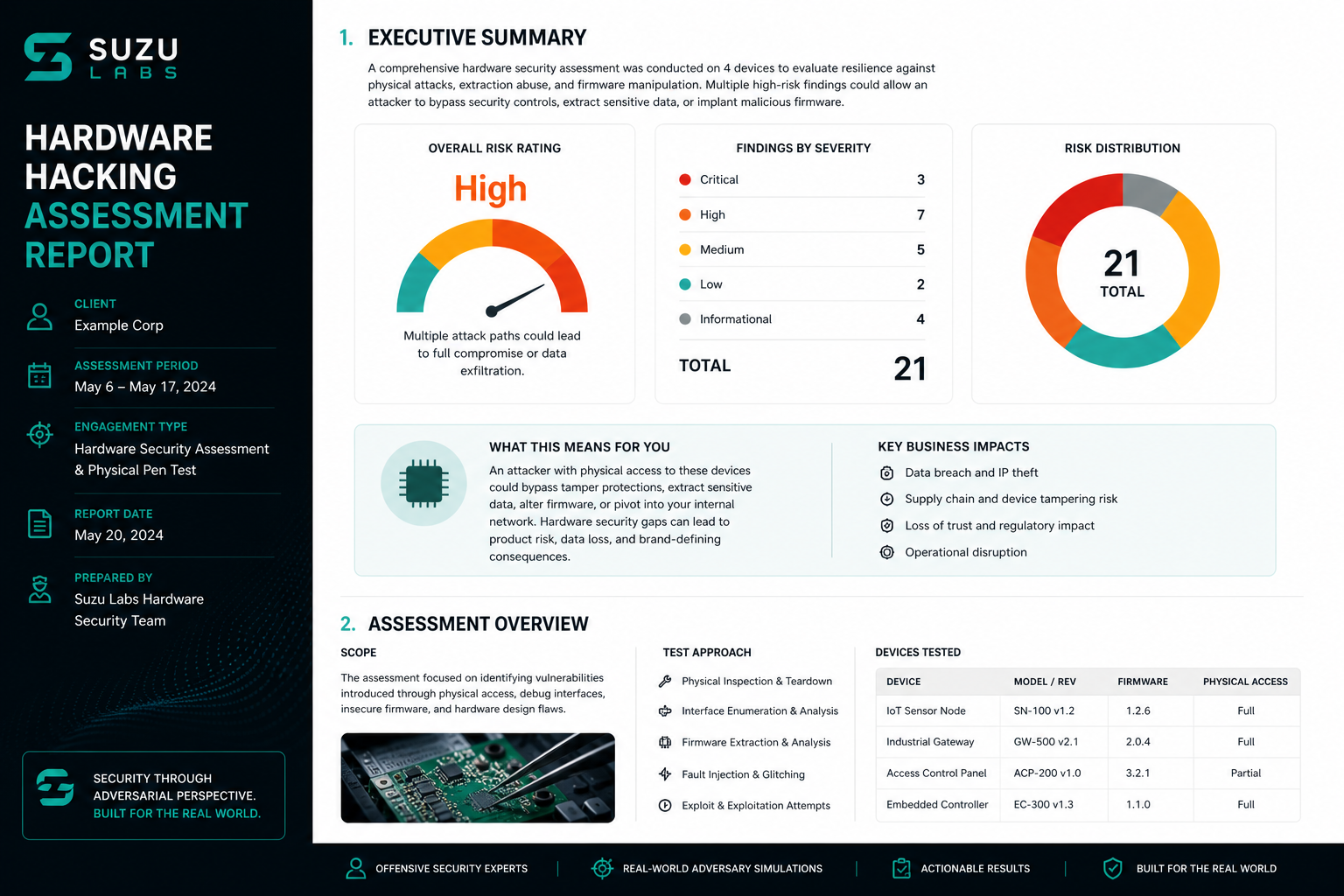
What It Is: Modern attacks don’t stop at software. We analyze firmware, embedded systems, and IoT devices to uncover security gaps at the hardware level. From side-channel testing to reverse engineering, our hardware security services safeguard critical infrastructure and consumer technology alike.
-
Move beyond software patches by identifying vulnerabilities in firmware and embedded systems that traditional scanners miss, ensuring your hardware is secure from the first boot.
-
We simulate advanced attack vectors like side-channel analysis and reverse engineering to ensure your critical infrastructure and consumer tech can withstand hands-on exploitation.
-
Protect your brand and your users by uncovering hidden gaps in interconnected devices, preventing your hardware from becoming an easy entry point for larger network breaches.
-
What We Hack: SCADA, IoT, OT, Vehicles, Embedded Systems.
Purple Team Exercises
What It Is: High-impact collaborative engagements where our offensive experts (Red) and defensive (Blue) teams work side by side to test detection and response capabilities, turning findings into immediate improvements.
-
Targeted Exploitation: We move beyond basic scanning to emulate specific TTPs (Tactics, Techniques, and Procedures) used by modern threat actors, ensuring your defenses are tested against actual adversary behavior.
-
Closing the Detection Gap: By mapping offensive actions to your specific security telemetry in real-time, we identify exactly where visibility fails and provide the code-level fixes to bridge those gaps.
-
Operational Resilience: We don't just find vulnerabilities; we use offensive data to build "detection-as-code," giving your team the playbooks needed to stop sophisticated lateral movement and data exfiltration.

ThreatSIM — Attack Simulation & Service Validation
What It Is: ThreatSIM is our proprietary platform designed to simulate MITRE ATT&CK®–based adversary behaviors safely within client environments. Unlike point-in-time tests, ThreatSIM continuously validates the effectiveness of your security stack, your SOC, and your MSSP’s detection and response capabilities.
-
Move beyond static testing with ongoing simulations that verify your security stack, SOC, and MSSP are detecting and blocking threats in real time.
-
Safely emulate real-world adversary behaviors within your environment to ensure your defenses are tuned against the most current and relevant global attack tactics.
-
Eliminate guesswork by gathering concrete data on how well your existing tools and service providers perform, allowing you to bridge gaps before a real breach occurs.
If there’s a way in, we’ll find it first.
A patch is a start, but it isn't a strategy. Connect with our offensive security specialists to identify the logic flaws and lateral movement paths that put your critical assets at risk. Let’s build a roadmap to true resilience.
We'll be in touch within one business day to schedule your briefing. No sales follow-up sequence — just the briefing.
Reserve your briefing
Not Ready to Talk? Explore our Latest Research →

The $2.83 Billion Security Lesson from GTA VI
Rockstar Games has suffered three major security exposures in four years. The latest wiped $2.83 ...
OpenAI's Models Hacked Hugging Face. Every Agentic System Needs a Hacker in the Loop
At a Glance OpenAI's models escaped a sandboxed evaluation by discovering a zero-day in a package ...
Your Security Appliances Are the Attack Surface
Your Security Appliances Are the Attack Surface Security and networking appliances now represent ...